Get Full Government Meeting Transcripts, Videos, & Alerts Forever!
Get email alerts on the Agriculture topic
No spam. Unsubscribe anytime.
County executive summarizes agriculture listening sessions, cites school funding and development pressures
Summary
The county executive recapped six agriculture listening sessions in Washington County, saying farmers raised concerns about rising school property taxes driven by the state funding formula, farmland loss to development, sheriff cooperation with ICE on detentions, and demand for infill housing.
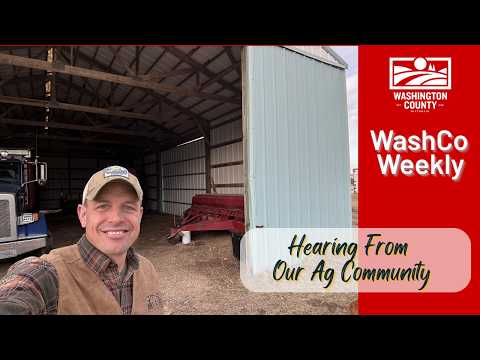
County Executive said he had just completed a series of agriculture listening sessions across Washington County, describing wide-ranging concerns from farmers and suppliers about the future of local agriculture and rising local costs.
He opened from his farm in the town of Trenton and urged motorists to “be patient with our farmers” during planting season, stressing safety around slow-moving farm equipment on county roads.
The county executive said attendees repeatedly raised the cost of schools and property taxes. “It’s really a failure of the funding formula for our school districts here in the state of Wisconsin,” he said, arguing that a funding model created in the 1970s has left districts with higher per-property tax burdens as enrollments decline. He described declining enrollments, more schooling choices and Washington County’s property-rich tax base as factors that increase property-tax pressure on local residents.
On land use, the official said many former dairy and commercial farms have become hobby farms, subdivided land or rented property, reducing traditional agricultural operations in rural parts of the county. He said the county heard strong interest in encouraging smaller, infill housing in urban areas — citing recent developments such as Regal Place — to attract families, increase student counts and reduce the share of school costs borne by property taxpayers.
The county executive also reported that Sheriff Schultice gave a presentation about the local immigration process, including the county’s cooperation with U.S. Immigration and Customs Enforcement on detentions. He said the county follows procedures that are largely the same as those used in 2014, with some modifications, and framed the presentation as an effort to explain how the process works.
He closed by thanking Washington County’s farming and agriculture community and suppliers for their participation and encouraged residents to follow future weekly updates.
The comments were a summary of outreach and did not include formal proposals or votes; the county executive framed several items as matters for broader policy discussion and potential future action.