Get Full Government Meeting Transcripts, Videos, & Alerts Forever!
Get email alerts on the Pfas Testing Guidance topic
No spam. Unsubscribe anytime.
MassDEP walks wastewater operators through revised PFAS testing guidance; stresses EPA method 1633 and eDEP uploads
Summary
MassDEP staff outlined a revised facility guidance document clarifying PFAS testing, sampling and data‑submission expectations for NPDES permit holders and POTWs, emphasizing use of EPA Method 1633 for compound‑specific analysis and eDEP uploads in addition to NetDMR.
Nicole Galambos, who said she works with the NUPTI's group at the Massachusetts Department of Environmental Protection, walked wastewater operators through a revised facility guidance document for PFAS testing and reporting, stressing that the document reiterates existing requirements rather than creating new ones. "This document is a reiteration of existing requirements, so they're not new requirements," Galambos said.
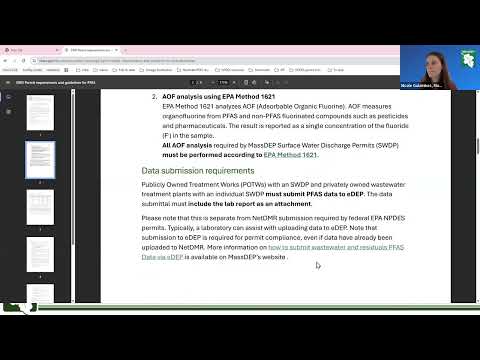
The guidance clarifies analytical and submission requirements tied to surface water discharge and NPDES permits and directs facilities to use EPA Method 1633 for compound‑specific PFAS analysis. "The way that the NPDES permits now require analyzing for specific compounds ... is through EPA method 1633," she said, adding the method can measure about 40 PFAS compounds and that "all PFAS analysis, required by MassDEP surface water discharge permits must be performed according to this method." For permits that require an aggregate measure, Galambos noted durable organic fluorine (AOF) testing should follow EPA Method 1621.
Galambos emphasized data‑submission steps operators frequently miss: in addition to any NetDMR uploads required by NPDES permits, POTWs and holders of individual MassDEP surface water discharge permits must upload PFAS lab reports to eDEP with the lab report attached. "For POTWs and holders of individual surface water discharge permits ... PFAS data must be submitted through eDEP with the lab report attached," she said, and advised facilities to have labs generate correctly formatted files for eDEP uploads.
On sampling, Galambos said permits specify locations and matrices (influent, effluent, sludge) and recommended taking influent and effluent samples at the same compliance points and sampling final sludge products for sludge results. She noted EPA Method 1633 generally prefers grab sampling because PFAS can adsorb to surfaces and composite sampling requires specialized protocols. "Grab sampling is preferred to composite sampling," she said, and referenced EPA letters clarifying that grab sampling satisfies requirements for small and medium POTW general permits.
The presentation included practical guidance for chains of custody and quality control: include the NPDES permit ID and the analytical method (1633) on chain‑of‑custody paperwork, and use one of eDEP's four matrix options (influent, effluent, sludge, industry) to reduce lab and upload errors. Galambos recommended field blanks (not required by permit) to check for sampling contamination, explained when duplicate samples or reextraction may be needed for quality‑control reasons, and said facilities with low total solids in sludge should request total solids reporting because most sludge results are reported on a dry‑weight basis (nanograms per gram) while low‑solids sludge may be reported as nanograms per liter.
Galambos closed by pointing participants to the guidance and supplementary links posted on mass.gov and offering her email for follow‑up questions. The document and supporting resources are available on MassDEP's PFAS in wastewater and residuals web page.