Get Full Government Meeting Transcripts, Videos, & Alerts Forever!
Get email alerts on the Access Payment Mechanics topic
No spam. Unsubscribe anytime.
How ACCESS payments, withholds and performance adjustments will work
Summary
CMS staff explained ACCESS billing, monthly payments with a six‑month pay/withhold structure, a 50% outcome attainment threshold for full payment, and a substitute‑spend threshold set at 90% (with a 25% cap on adjustments).
CMS Innovation Center director Brian Walderson detailed how ACCESS ties payment to performance and how monthly billing and reconciliation will operate.
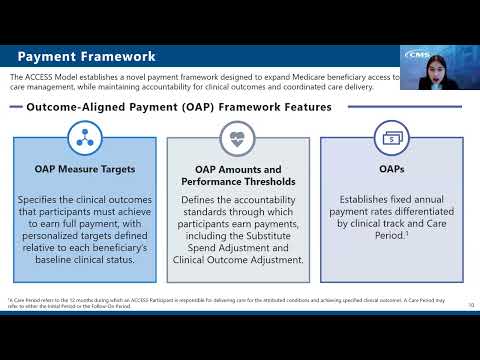
ACCESS participants will submit claims using track‑specific G‑codes. CMS will pay monthly amounts equal to one‑twelfth of the Medicare portion of the allowed annual OAP. CMS will pay those monthly payments in months 1–6 (up to 50% of the Medicare portion) and withhold payments for claims submitted in months 7–12 for reconciliation at the end of each 12‑month care period.
Reconciliation uses two potential downward adjustments; CMS applies the larger of the two to the Medicare portion of the OAP. The substitute spend adjustment reduces payments when aligned beneficiaries receive duplicative Medicare services from other providers above a defined substitute spend threshold. For the initial implementation period (July 5, 2026–Dec. 31, 2027) the substitute spend threshold is set at 90%; substitute spend rates below the threshold yield proportional payment reductions, capped at 25% of the OAP. Substitute services will continue to be reimbursed under normal Medicare rules.
The clinical outcome adjustment compares each participant’s outcome attainment rate (OAR) — the share of aligned beneficiaries who met all required OAP measure targets and submission requirements — to an outcome attainment threshold (OAT). CMS set the OAT at 50% for July 2026–2027. Participants with OARs at or above 50% will receive 100% of withheld amounts; participants below that threshold will receive a proportional payment calculated as OAR divided by OAT. CMS excludes beneficiaries who relocate outside an access participant’s licensed service area or become ineligible during the care period from the OAR numerator and denominator; beneficiaries lost to follow‑up or who initiate alignment remain in the denominator.
Walderson illustrated multi‑track and multi‑service rules with an example in which a beneficiary enrolled in two tracks with the same participant generated a 5% multi‑track discount on the lower‑cost track for overlap months. He also described an example annual OAP split ($24/month for one track and $12/month for a second track) showing how the 5% discount adjusts the lower‑cost track at reconciliation.
“Payment amounts are subject to two potential downward adjustments — a substitute spend adjustment or a clinical outcome adjustment — and CMS will apply whichever percentage is greater,” Brian Walderson said.
CMS will publish billing instructions and the specific G‑codes in advance of the model launch. Presenters cautioned that consistent underperformance relative to the OAT may subject participants to termination under CMS monitoring.