Get Full Government Meeting Transcripts, Videos, & Alerts Forever!
Get email alerts on the Access Model Overview topic
No spam. Unsubscribe anytime.
CMS unveils ACCESS: a 10‑year outcome‑aligned Medicare model to expand tech‑enabled chronic care
Summary
CMS Innovation Center leaders outlined ACCESS, a voluntary 10‑year outcome‑aligned payment model for Original Medicare starting July 5, 2026, that pays organizations by measurable patient outcomes across four clinical tracks and opens applications for the first cohort April 1.
CMS Innovation Center co‑lead Pooja Nyer announced the Advancing Chronic Care with Effective Scalable Solutions (ACCESS) model as a nationwide, 10‑year voluntary demonstration starting July 5, 2026, to expand Medicare beneficiaries’ access to technology‑enabled chronic care.
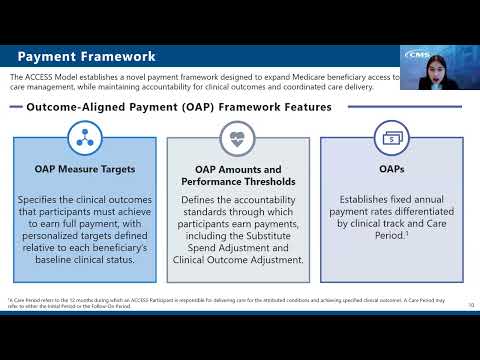
The model tests outcome‑aligned payments (OAPs) that tie recurring payments to measurable clinical and patient‑reported outcomes rather than paying for individual activities, Nyer said. The program aims to give technology‑enabled care organizations flexibility to deliver continuous, coordinated chronic care while publicly reporting participant performance to help patients and clinicians choose providers.
ACCESS initially establishes four clinical tracks: Early Cardio‑Kidney‑Metabolic (ECKM) for early intervention, Cardio‑Kidney‑Metabolic (CKM) for more advanced disease, Musculoskeletal (MSK) for chronic musculoskeletal pain, and Behavioral Health for depression and anxiety. Each track uses condition‑specific outcomes — for example, blood pressure, hemoglobin A1c and LDL‑C in the ECKM/CKM tracks — to determine payment eligibility and reconciliation at the end of a 12‑month care period.
“Access is designed to address these barriers by introducing an innovative payment option that focuses on measurable health outcomes rather than paying for activities,” Pooja Nyer said during the webinar.
Organizations apply at the TIN level. To be eligible, participants must be enrolled in Medicare Part B, be a legal entity authorized to do business in operating states, designate a Medicare‑enrolled physician as medical director, and ensure all providers delivering or supervising care are individually enrolled in Medicare and have reassigned billing rights to the participant TIN. Prospective applicants must obtain NPIs and submit Medicare Part B enrollment via PECOS; CMS advised starting enrollment early because approval can take time. CMS will allow a Medicare‑enrollment grace period but requires organizations to be Medicare enrolled by June 1, 2026, to sign the participation agreement.
Applications opened January 12 and the Access team said the implementation guide and API documentation will be released in March, with an API implementation office hour scheduled in mid‑March. Applications for the first cohort are due April 1; selected applicants will be notified in late spring and the first cohort will begin July 5, 2026.
The webinar also described operational particulars such as initial‑period versus follow‑on period payments (the initial period reflects onboarding and higher resource needs) and a rural add‑on: for some ECKM/CKM beneficiaries in rural areas CMS will add a fixed $15 payment in the initial period to offset operational costs. Allowed amounts represent the maximum annual payment per beneficiary and include the Medicare program payment (80%) and a beneficiary coinsurance (20%); participants may choose to forgo collecting coinsurance as an incentive.
Materials the presenters referenced — the Request for Applications (RFA), the payment amounts and performance targets paper, and the upcoming implementation guide and API documents — will be posted on the ACCESS model web page. The Access team directed attendees with further questions to accessmodelteam@cms.hhs.gov.
Next steps: applicants should review the payment amounts and performance targets paper, begin Medicare enrollment if needed, and monitor the ACCESS web page for the implementation guide, API documentation, and office hour invitations.