Get Full Government Meeting Transcripts, Videos, & Alerts Forever!
Get email alerts on the Assault Weapons topic
No spam. Unsubscribe anytime.
Senate committee advances assault‑weapons ban after emotional testimony from Annunciation families
Summary
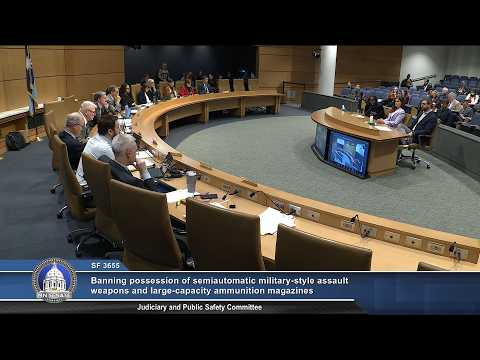
After testimony by survivors, first responders and doctors about the Annunciation Church shooting, the Senate Judiciary Committee adopted authors' amendments to Senate File 3655 and voted 6–3 to recommend the bill as amended and refer it to the Finance Committee.
Sen. Zaynab Mohamed, the chief author of Senate File 3655, opened the Judiciary Committee hearing by recounting the Aug. 27, 2025, shooting at Annunciation Church that killed two children and wounded dozens. Mohamed framed the bill as a response to what she described as the catastrophic effects of assault‑style rifles and high‑capacity magazines and said the measure would reduce the scale of future mass shootings.
Multiple witnesses described the August attack in vivid detail. Lieut. Andrew Schroeder of the Minneapolis Police Department, who led the homicide investigation, provided a minute‑by‑minute timeline of the attack and said examiners collected 116 shell casings at the scene. Parents Jackie Slavin and Mike Moyski gave emotional testimony about the deaths of their child Harper Moyski and other victims and urged the committee to act. Dr. Rachel Weikert, a pediatric emergency physician at Children’s Minnesota, testified about treating children injured in the attack and said high‑velocity rifle rounds cause catastrophic injuries to small bodies.
Supporters from veterans groups and child‑advocacy organizations also testified in favor of the bill, arguing that these weapons and magazines produce unusually high casualty counts and that policy should weigh that harm. Opponents, including a transgender rights speaker and others, said the bill was overbroad, would not address the primary drivers of violence, or could penalize lawful owners; one speaker argued it would shift enforcement resources away from detecting genuinely dangerous people.
Committee counsel and the author worked through a series of authors’ amendments. The A4 amendment removed provisions allowing local law enforcement warrantless inspections of private homes and shifted certification duties to the Bureau of Criminal Apprehension (BCA); the A5 amendment made related technical substitutions and ensured references to the BCA were consistent across the draft. Counsel said the A4 deletion removed language that would have allowed law enforcement to enter homes to inspect whether someone possessed a prohibited semiautomatic weapon or a large‑capacity magazine.
After questions from multiple senators about definitions (including what constitutes a large‑capacity magazine), safe‑storage and the certification timeline for inherited weapons, Sen. Westlin moved that the bill as amended be recommended to pass and be referred to the Finance Committee. The committee requested a roll call; recorded votes included Chair Latz and Vice Chair Oumou Verbeten voting in favor, Senators Pappas, Seebeger and Westlin voting in favor, and Senators Holmstrom and Kreun voting no. A member expected to vote by Zoom was not heard; the clerk announced the motion prevailed by a tally of six in favor and three opposed.
The motion sent SF3655, as amended, to the Finance Committee for further consideration.
Ending: The committee’s action ends the public‑testimony phase in Judiciary; any substantive changes are likely to be made in finance or as the bill moves toward a floor debate. The author said she plans to continue working with colleagues across the aisle on technical revisions.