Get Full Government Meeting Transcripts, Videos, & Alerts Forever!
Get email alerts on the Bonding And Tab Fee Reform topic
No spam. Unsubscribe anytime.
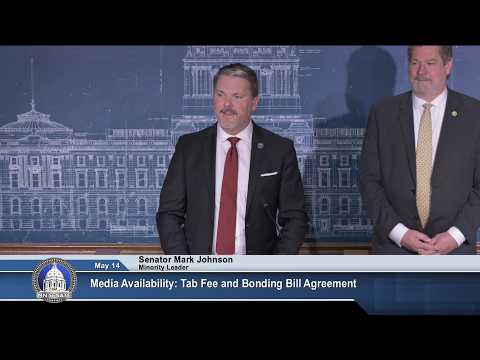
Senator outlines $1.2 billion bonding deal, $254 million tab-fee cut and anti-fraud steps
Summary
At a Capitol briefing, a lawmaker (S2) described a tentative $1.2 billion bonding package that includes $254 million in tab-fee relief for 2027 and anti-fraud measures such as electronic verification; reporters pressed officials on the one-year nature of the fee cut and outstanding allocation details.
At the Capitol, S2 (Senator) told reporters the negotiated package includes a $1,200,000,000 capital investment (bonding) bill, a $254,000,000 tab-fee reduction slated for 2027 and new anti-fraud measures including electronic verification of provider visits.
“This is a 1,200,000,000 capital investment bill,” S2 said, describing funding for state assets and projects in small and large Minnesota communities. S2 said the package also contains “a number of issues in there that are anti fraud related,” and highlighted electronic verification to ensure providers are actually at service sites.
S2 framed the tab-fee reduction as taxpayer relief tied to a previous change in the 2023 transportation bill and said Republicans had prioritized cutting tab fees as part of bonding negotiations. “That’s $254,000,000 that Minnesota taxpayers are gonna be saving in 2027,” S2 said.
Reporters pressed for details and permanence. S4 asked whether the reduction was merely “a 1 year blip,” and S2 said the reduction is currently designed as a one-year reprieve effective Jan. 1, 2027, and that negotiators intend to revisit affordability next session. “This is a 1 time break, obviously,” S2 said.
On how much individuals would save, S1 provided an example used in the briefing: on a $50,000 vehicle the negotiated rate reduction would amount to about $145. S1 emphasized that savings can add up for households with multiple vehicles and said road and bridge funding “is being 100% backfilled,” addressing concerns that the reduction would reduce road revenue.
S2 described negotiation tradeoffs, saying some caucus priorities were not included but that tab-fee relief and anti-fraud measures remained central wins for their side. S2 also credited House Republicans’ negotiating role and said tax chairs and leads are still working through how the $1.2 billion will be allocated across project “buckets.”
Not all numerical statements in the briefing were coherent as presented. S2 said the package includes “an excess tax of a 100% on the fraudsters” and then offered an example that a fraudster who “made 1,000,000 dollars in fraud” would “have to pay a $100,000 in restitution.” Those two figures are inconsistent (a 100% penalty on $1,000,000 would be $1,000,000); the speaker did not clarify the discrepancy during the briefing.
S2 said the bonding amount is near the state’s capacity: “we were very reluctant to go up to $1,200,000,000” and the package sits at “the upper extremity of what we’re comfortable with.” S2 said that, while the bonding portion appears likely to hold, details of how the $1.2 billion is divided remain under negotiation.
No formal motions or votes were conducted during the briefing. S2 said the next step is for tax chairs and caucus leads to finalize allocations; press questions focused on whether the tab-fee reduction would be extended beyond 2027 and on greenhouse-gas language that S1 said could increase local road and bridge costs by “about 30 to 50%.”
The briefing closed with no procedural actions taken and with officials saying they will continue negotiating the package components and timing.