Get Full Government Meeting Transcripts, Videos, & Alerts Forever!
Get email alerts on the Federal Budget Immigration Enforcement topic
No spam. Unsubscribe anytime.
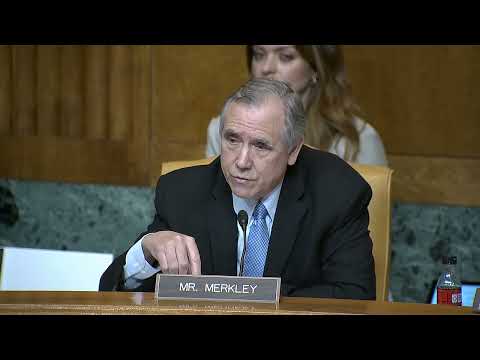
Sen. Merkley and witnesses say bill would add tens of trillions to debt, worsen immigration enforcement impacts
Summary
At a Senate Committee on Appropriations hearing, witnesses cited CBO estimates that a recently debated bill would add about $4.7 trillion to the 10-year deficit and roughly $30 trillion over 30 years; witnesses and Sen. Merkley also warned the bill’s enforcement provisions could shrink the workforce and limit civil-rights remedies.
Sen. Merkley questioned witnesses at a Senate Committee on Appropriations hearing about the fiscal and enforcement consequences of a bill some witnesses and the senator described as adding substantially to the federal debt.
"CBO shows it adds $4.7 trillion to the deficit," Mr. Duke said when asked about the bill’s 10-year impact, and he told the committee the measure would add roughly $30 trillion over 30 years. Asked how a one-percentage-point higher interest rate would affect the tally, Mr. Duke said, "I cannot believe I'm saying these numbers, but $50 trillion."
Sen. Merkley responded by linking the projected debt increase to cuts in public investment, saying, "Thanks a lot, folks, for passing a bill that will add 30 to $50 trillion to our debt, suppressing our investment in health care, housing, education, public safety, transportation."
Witnesses also told the committee that the bill’s immigration-enforcement provisions would reduce the working-age population and shrink the tax base. "CBO says it will shrink the number of people who are in the workforce because they are going to leave the country or be in detention camps," Mr. Duke said.
On enforcement practice, the witnesses described coordination between federal and local authorities. Sen. Merkley asked whether state or local police fully cooperate in detaining people for federal authorities; Mr. Bier said they do and outlined how local fingerprints and arrest records are available to federal agents. Mr. Bier and another witness described an example cited in the transcript as the "Laken Riley Act" in Virginia, saying federal actions had, in their view, produced profiling of Hispanic workers rather than targeted warrant-based removals. "They're out on the streets profiling random Hispanic workers going to their job," Mr. Bier said.
Mr. Bier also summarized written testimony about Department of Homeland Security threat assessments, saying roughly 10% of individuals received the highest threat level while about 70% were assessed as not a threat. Sen. Merkley contrasted those figures with campaign promises to focus on violent offenders, noting that a chart in testimony indicated only about 5% of people booked by ICE had violent criminal convictions.
On remedies, Sen. Merkley and the witnesses discussed private causes of action for civil-rights violations. The committee exchange noted that 42 U.S.C. § 1983 provides a cause of action against state actors but not federal officers, and witnesses flagged concerns that federal-local cooperation can result in gaps in accountability.
The hearing record provided no formal votes or committee action on legislation during this exchange. The questioning continued after the last quoted remarks; no vote was recorded in the provided transcript.