Get Full Government Meeting Transcripts, Videos, & Alerts Forever!
Get email alerts on the Corporate Spending Reform topic
No spam. Unsubscribe anytime.
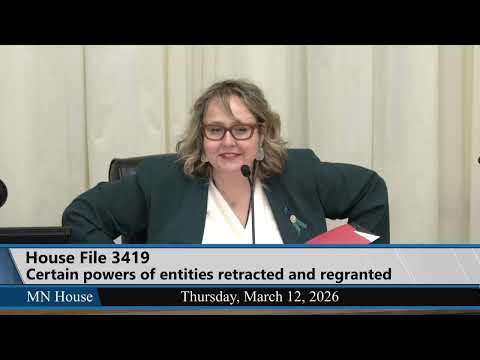
Commerce committee deadlocks 10–10 on proposal to bar corporations from political spending
Summary
After several hours of testimony and questioning on March 12, the committee failed on a 10–10 roll call to move House File 34‑19, a bill that would remove political‑spending powers from corporate charters. Supporters called it a state‑level route to limit "dark money;" opponents warned of constitutional risk and litigation costs.
The Minnesota House Commerce Finance and Policy Committee on March 12 debated House File 34‑19, a high‑profile proposal to prevent corporations from using their general corporate powers to spend money in Minnesota elections. After multiple witnesses and extended member questioning, a roll call to move the bill to the General Register ended in a 10–10 tie and the motion failed.
Sponsor Representative Green Men told the committee the bill "simply removes the power of political spending from the bundle of charter powers that the state of Minnesota chooses to extend to all artificial entities," framing the measure as a state‑law approach to limit outside spending that supporters describe as "dark money." The sponsor and allied witnesses cited multi‑decade increases in outside election spending and argued states can constrain corporate political influence by clarifying what powers corporate charters confer.
Supporters included David Fischer of Clean Elections Minnesota and Tom Moore of the Center for American Progress, who argued the measure is a legally distinct way to address Citizens United‑era spending by limiting the powers the state grants to corporate entities. Several citizen testifiers and policy advocates described the bill as a transparency and accountability measure that would require spending to flow through regulated political committees.
Opponents included Brian Cook of the Minnesota Chamber of Commerce, who warned of constitutional problems and legal costs and cited the chamber's prior litigation that blocked enforcement of a 2023 statute. Cook testified that "there are numerous constitutional issues" with the approach and urged the committee to reject the bill.
Committee members asked detailed questions about effects on unions and nonprofits, 501(c)(4) organizations, foreign entities authorized to do business in Minnesota, the possibility of circumvention by spinning off political committees, and whether wealthy individuals would remain able to spend personally. Sponsors and supporters said the measure was drafted to cover both domestic and foreign corporations doing business in Minnesota and to direct political spending into regulated political committees; opponents said the drafting raised unresolved constitutional and implementation questions and could cost the state in litigation.
Representative Freeman requested a roll call to record positions. On the roll call the clerk recorded 10 ayes and 10 nays; the motion to send HF 34‑19 to the General Register did not prevail. Several members urged further discussion and technical review; others said the subject belongs in the Elections Committee for specialized review.
Next steps: HF 34‑19 did not advance from the Commerce committee on March 12. The sponsor indicated possible further amendments and supporters said they would continue outreach to colleagues; opponents signaled likely litigation if the bill passes.