Get Full Government Meeting Transcripts, Videos, & Alerts Forever!
Get email alerts on the Higher Education Bonding topic
No spam. Unsubscribe anytime.
Minnesota State and University of Minnesota outline 2026 bonding requests, students urge investment in Saint Paul campus
Summary
Minnesota State and the University of Minnesota presented their 2026 capital requests to the Capital Investment Committee, emphasizing preservation, targeted demolition and student-space upgrades; a Saint Paul student described chronic infrastructure problems and the dental school outlined capacity and workforce needs.
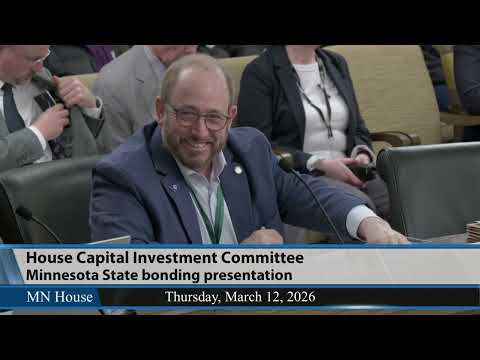
Minnesota higher-education leaders asked the Capital Investment Committee on March 12 for bonding support to renew aging facilities, demolish obsolete buildings and expand student and clinical spaces.
Bob Bryan Swanson, associate vice chancellor for facilities for Minnesota State Colleges and Universities, said the system's 2026 request centers on preserving and modernizing existing campuses rather than adding new square footage. "I'm here to talk about our 2026 bonding request at its core. The request before you is about providing some pretty basic facilities to serve students that make up Minnesota's current and future workforce across the state," Swanson told the committee. He noted a detailed packet in members' materials and referred to a systemwide request listed in the packet (the book lists a roughly $200 million request) and a $25 million demolition line that would target about 16 buildings and roughly 500,000 square feet.
The system emphasized a "no net growth" approach and prioritized projects that replace or modernize obsolete 1960s-era facilities. Swanson said demolition saves operating costs, reduces deferred maintenance and cuts the state's carbon footprint.
The University of Minnesota followed with Robert Davis, vice president for university services, laying out three priorities: a systemwide asset preservation request described in testimony as a $100 million line; an $84 million Saint Paul campus center project; and a $100 million renovation of Moos Tower to modernize the School of Dentistry. "When a roof fails or HVAC system goes offline, it doesn't just damage the building. It displaces students. It interrupts life-saving research and ultimately costs the state more money," Davis said, urging timely investments.
Riley Hadley, an undergraduate student and Saint Paul campus student-body president, told lawmakers the campus infrastructure undermines student life and recruitment. "Our infrastructure, though, does not meet that same standard. There's flooding. There's mice. There's asbestos. There's power outages and... there's no food options," Hadley said, asking the committee to support a new student center to restore campus life and operations.
Officials from the School of Dentistry argued the Moos Tower renovation would expand training capacity at a time when retirements outpace graduations. The dean noted the school provides roughly 90,000 patient visits annually and said renovating clinical space would support digital dentistry and team-based care while addressing the state's dentist workforce shortfall.
Committee members asked detailed operational questions about demolition plans, reuse of cleared sites and how university capital plans align with staffing and clinic capacity. Swanson said most demolition sites would be landscaped and left as green space after consolidation; University officials said they are aligning staffing and clinic chairs where possible but acknowledged legal and records barriers in quickly transferring tens of thousands of patients when an external clinic closed.
No bonding bills were voted on during the hearing. The committee heard the requests, asked follow-up questions and signaled interest in further conversations during the bonding cycle.
The committee adjourned with the next hearing scheduled for March 17.