Get Full Government Meeting Transcripts, Videos, & Alerts Forever!
Get email alerts on the Estate Planning topic
No spam. Unsubscribe anytime.
Committee backs bill to recognize electronic signatures for estate-planning documents
Summary
The House Judiciary Finance and Civil Law Committee recommended HF 3560 for placement on the General Register after testimony that the bill would extend authority for electronic signatures to powers of attorney, health-care directives and trusts while preserving notarization and witnessing protections.
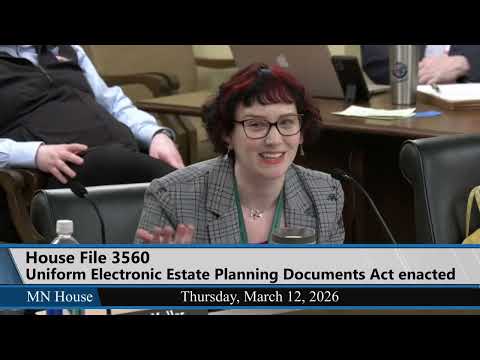
The House Judiciary Finance and Civil Law Committee on March 12 recommended House File 3560 — a Minnesota version of the Uniform Electronic Estate-Planning Documents Act — to be placed on the General Register.
Sponsor testimony said the bill fills a gap left after Minnesota adopted an electronic wills statute by making clear that other estate-planning papers — including powers of attorney, health-care directives and trusts — may be signed electronically when the document follows defined security, witnessing and notary procedures. "What this bill does is it gives express authority for using an electronic signature," said Kameron Kelly, an attorney and member of a probate legislative committee, who urged the committee to support the measure.
Testifiers from the Uniform Law Commission and the State Bar Association described the measure as modeled on a 2022 uniform act adopted in several other states and noted protections such as identity proofing and audit trails attached to signing platforms. "The act puts emphasis on security procedures ... Documents that follow those procedures will probably be getting less scrutiny than a document that doesn't," one testifier said, pointing to audit logs used by services such as DocuSign.
Supporters argued that electronic signatures would improve access for homebound Minnesotans and residents in rural "legal deserts" who otherwise have difficulty visiting an attorney in person. Witnessing and notarization requirements where already statutorily required would remain in place under the bill, they said.
Opponents did not appear at the committee hearing. Committee members asked clarifying questions but generally signaled comfort with the measure after state bar and uniform law commissioners described the safeguards. Chair Scott moved that HF 3560 be recommended to pass and placed on the General Register; the committee approved the recommendation by voice vote.
The committee’s action places the bill on the General Register for further floor consideration; no final enactment was taken at the committee level.