Get Full Government Meeting Transcripts, Videos, & Alerts Forever!
Get email alerts on the Environment Trust Fund topic
No spam. Unsubscribe anytime.
Senate committee advances Environmental & Natural Resources Trust Fund bill with new grant oversight rules
Summary
The Finance Committee recommended Senate File 3857 to the floor on March 12. The bill carries LCCMR recommendations for 109 projects and community grants pilot provisions; the committee adopted an A13 amendment that requires preaward risk assessments, sampled financial reconciliations, biannual reporting for elevated-risk grants, monitoring, and staff training.
St. Paul — The Senate Finance Committee on March 12 voted to recommend Senate File 3857, the Environment and Natural Resources Trust Fund bill that carries the Legislative‑Citizen Commission on Minnesota Resources’ (LCCMR) recommendations and includes a community grants pilot and grant‑oversight amendments.
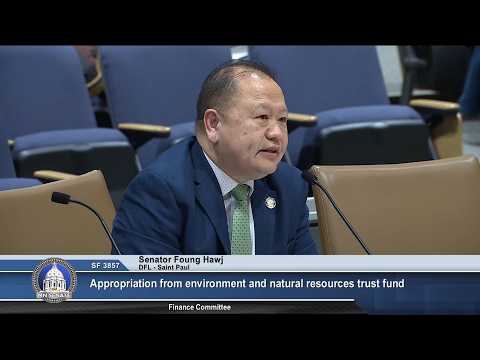
Sen. Harouna Hawj, sponsor of SF 3857, told the committee the bill implements LCCMR recommendations arising from a competitive review process. Director Nash of the LCCMR presented the recommended projects and described the process: the commission received a record number of applications (400) requesting about $359 million and recommended 109 projects at funding levels between roughly 68% and 100% of requested amounts. The commission organized appropriations by category (resiliency, water, education/outdoor recreation, fish and wildlife, energy, land, administration and carryforwards).
Mr. Stanley described the A13 amendment adopted by the committee. The amendment requires the Department of Natural Resources, when awarding community grants under the statute, to ensure statutory grants‑management requirements are met; to complete a preaward risk assessment; to conduct a financial reconciliation for a sample of grant expenditures; and, where elevated risk is found, to require biannual progress reports and impose additional safeguards such as limiting advance payments, setting a maximum grant size, and requiring in‑person monitoring visits based on project complexity, amount and risk. It also directs training for department staff on financial reconciliation and fraud prevention.
Sen. Hawj said the community grants pilot was designed to make smaller, locally accessible awards available to counties, municipalities, nonprofits and other community groups that can struggle to compete for larger LCCMR awards. He told the committee that, after the 2024 constitutional amendment, the pilot envisioned $56 million for community grants but that committee leaders split the initial disbursement to $28 million to phase implementation and monitor the program.
Members questioned the distribution of funding to academic institutions. Director Nash and Mr. Campana said the University of Minnesota submitted a large number of proposals (reported as 179) and had 33 recommended projects; Nash reported that the total recommended funding going to the University was $22.1 million, about 21.4% of the bill’s recommended funding. Some senators expressed concern that the fund should lead to projects and not primarily academic studies; Nash noted the fund includes research projects that undergo external peer review and that many projects produce usable outcomes.
Sen. Jasinski asked about patent and royalty arrangements for projects that generate commercializable technology. Nash said the statute requires a proportional return to the trust fund based on the fund’s share of development costs — not a transfer of ownership — and that the commission tracks license revenue, which staff said was currently small (less than $10,000 in the last year).
Mary Robison, chief financial officer for the Department of Natural Resources, said the DNR delivered a December report on the community grants approach, that an advisory council recruitment and member-application process is open through April 10, and that the agency has not yet begun full implementation pending formation of the advisory council and further legislative feedback.
Sen. Frentz moved that Senate File 3857 as amended be recommended to pass; the committee adopted the motion by voice vote. The transcript does not include a roll‑call tally. The committee packet included a spreadsheet of recommended projects and the detailed work plans for each recommendation.