Get Full Government Meeting Transcripts, Videos, & Alerts Forever!
Get email alerts on the Administrative Law topic
No spam. Unsubscribe anytime.
Taxation committee debates creating independent office of tax appeals; amendment narrows property-tax changes
Summary
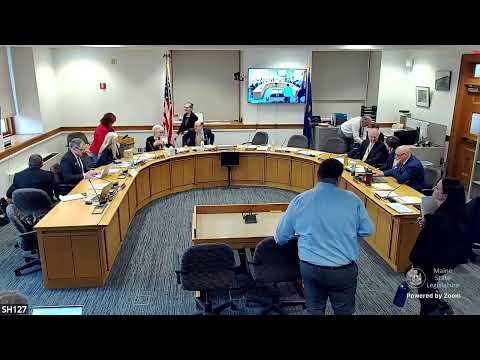
Committee heard a lengthy presentation from department staff and the bill sponsor on a proposal to create an independent office of tax appeals (LD278). After multiple amendments and questions about staffing, ethics standards and jurisdiction, the committee proceeded to a split roll call on a motion to report 'ought to pass as amended' (tie vote as recorded).
The Taxation Committee spent the bulk of the work session on a bill to establish an independent office of tax appeals and revise tax-appeals procedures. The measure (discussed as LD278 throughout the department presentation; the transcript later also references LD2178 when moving the motion) was presented by John Sagaser, tax policy council in the Office of Tax Policy at Maine Revenue Services, who laid out a department amendment that would preserve changes to the board of tax appeals while removing most of the property-tax provisions.
Sagaser framed the change as a practical step: “the amendment ... would drop all of part C except for minor administrative provision,” and he described retaining certain housekeeping provisions (for example, listing the state board of property tax review under supervisory authority) while removing broader property-tax rewrites that could be more disruptive. The department’s written amendment and Mr. Sagaser’s charts were offered to the committee for review.
Committee analyst Jessica Griswell (Office of Policy and Legal Analysis) summarized legal and drafting points the committee should consider in part B, including whether a change from the phrase “as a result” to “because” alters the causation standard for filing petitions, how many hearing officers the office should have (the department had indicated three in testimony but the draft language did not fix a number), and how to incorporate explicit conflict-of-interest or ethics standards into statute. Senator Mike Tipping and others pressed for clarity on ethics language; Griswell recommended incorporating a statutory cross-reference to the appropriate ethical rules where possible.
Members disagreed about whether to fold these reforms into an existing property-tax study process or to adopt a narrower, non-property-tax-focused office now. Senator Bruce Bickford called the amendment “a good start,” while other members warned a separate new office could duplicate work or add cost. The committee paused for a short caucus to consolidate the department’s amendment with Senator Bickford’s suggestions.
After reconvening the committee considered a motion to report the bill “ought to pass as amended.” The chair described the changes being proposed (retaining part A, focused part B revisions, and deletion of certain C/D/E subsections; moving and relettering specified paragraphs; and adjusting effective dates). A roll call was taken. The transcript lists members recorded in favor (Representatives Scott Haramman and Ann Matlac, the chair, Senator Mike Tipping and Representative Freriedman) and those recorded opposed (Representatives Gregory Swallow, Quint, “Rudiki”/Rodniki, Thomas Lavine and Russ White). The committee record as captured in the transcript indicates the motion did not carry (the roll call as printed resulted in a tie as recorded and the minute shows 'ought not to pass' in the record).
Committee members asked staff to return refined statutory language on points such as specifying the number of hearing officers and incorporating an explicit citation for ethical/conflict-of-interest standards before the bill is advanced further. Several members also recommended leaving some technical housekeeping items in place while deferring larger property-tax jurisdiction changes to a separate review.
Next procedural steps were not finalized during this work session; the committee caucused and then moved on to other business after the recorded vote on the amendment.