Get Full Government Meeting Transcripts, Videos, & Alerts Forever!
Get email alerts on the Education Enrollment topic
No spam. Unsubscribe anytime.
D-51 projects continued cohort-driven enrollment declines and warns of multimillion-dollar funding risk
Summary
At its Oct. 21 board meeting, Mesa County Valley School District No. 51 staff presented an enrollment forecast showing cohort-driven declines (470 fewer students this year) and a financial update that warned possible state policy changes could cut district funding by roughly $2 million to as much as $7 million, prompting early planning and calls for state advocacy.
At the Oct. 21 meeting of the Mesa County Valley School District No. 51 Board of Education, district staff presented linked enrollment and finance briefings that board members said will shape planning for the next several years.
Shannon, the district enrollment presenter, told the board the district’s October count shows 470 fewer students than the prior published count and that the loss is driven by cohort effects — notably “350 fewer kindergarteners than seniors.” "Students are not leaving Mesa County. They're not leaving our school district," Shannon said, arguing the change is demographic rather than mass outmigration. She forecast about a 397-student reduction next year and projected a decline of roughly 1,326 students over five years under current trends.
Why it matters: the enrollment patterns feed state funding formulas and the district’s budget planning. Shannon said limited new housing in much of the district and the fact that less than 1% of housing stock is new make housing-driven rebounds unlikely in the short term; some elementary attendance areas (Appleton, Fruita Monument, Monument Ridge, Rimrock) are expected to grow, while many other schools will shrink.
In a linked financial briefing, district finance lead Mel reported the 2024–25 fiscal year closed slightly stronger than expected — about $1.2 million above March projections — and left the district with unassigned fund balances around 23.1% of expenditures. "Reserves are one-time dollars and not an ongoing source of funding for operating expenses," Mel said, noting roughly $3.22 million of unassigned balance is earmarked to pay one-time COLA and lump-sum staff payments agreed after the budget was adopted.
Mel described near-term pressures in several funds: the preschool/UPK fund used approximately $142,000 of reserves and receives a current-year general-fund transfer of $400,000; nutrition services used about $350,000 of reserves as meal reimbursements lag rising costs; and risk-management (Fund 64) used about $1 million of reserves last year, driven by higher premiums and claims. Mel recommended increasing the annual transfer to the risk fund by at least $500,000 and developing a longer-term plan to shore up that fund.
Board members and staff framed the larger risk as state- and federal-level funding uncertainty. Mel and board members said the state’s projected budget shortfall and possible changes to student-count averaging could reduce the district’s revenue materially: participants discussed ballpark impacts ranging from roughly $2 million to as high as $7 million depending on which averaging or hold-harmless policies are used. One board member said a rollback similar to last year could produce the larger figure; Mel described $2 million as a plausible ballpark hit if averaging is shortened to two years but cautioned final counts and state decisions will determine the actual amount.
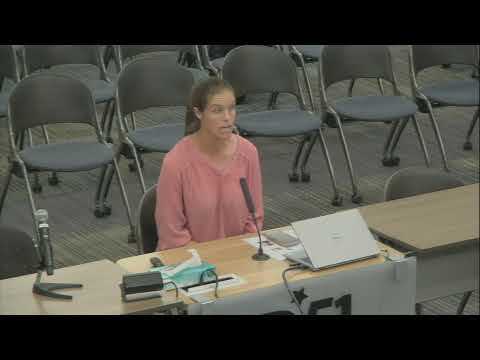
Public comment that followed underscored classroom impacts. A teacher identified as Miss Hicks said her second-grade class includes many students two grade levels below expectations, that interventionists were lost and class sizes are high, and she urged the board to consider how budget choices affect instruction.
What’s next: staff said they will continue to refine projections after the official October student count and the governor’s Nov. 1 budget proposal and will bring updates as those data arrive. Board members discussed local advocacy to state lawmakers and the possibility of exploring local revenue options such as a mill levy if state reductions materialize.
Provenance: enrollment material begins with Shannon’s presentation (topicintro SEG 474) and the financial discussion and state-funding Q&A extend through the end of the fiscal discussion (topfinish SEG 1765).