Get Full Government Meeting Transcripts, Videos, & Alerts Forever!
Get email alerts on the Safe At Home topic
No spam. Unsubscribe anytime.
Committee advances Safe at Home bill adding protections for emancipated minors, adopts misdemeanor change
Summary
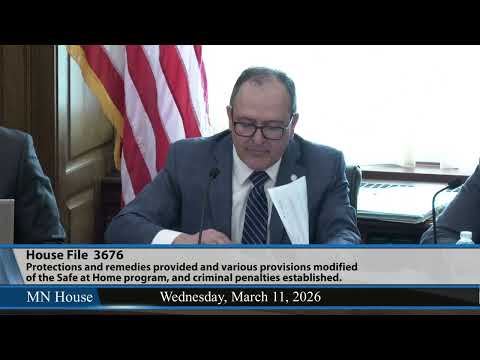
The Transportation Finance and Policy Committee approved amendments to HF 36, 76 on March 11, 2026, expanding Safe at Home eligibility to emancipated minors and reducing a proposed felony penalty to a gross misdemeanor; the bill was sent to the General Register.
The Minnesota House Transportation Finance and Policy Committee on March 11 advanced House File 36, 76, a package of technical and protective changes to the Safe at Home program, sending the bill to the General Register.
Representative Nash said the bill began after constituent cases and conversations with the Secretary of State’s office and includes changes to help people who use the program. “We owe it to people who take advantage of this program to make them invisible to their abuser,” Nash told the committee as he described adding emancipated minors to eligibility rules and other statutory updates.
Nicole Freeman of the Secretary of State’s office described the A4 amendment, which removes a section about use of the Safe at Home address for business bank accounts while officials seek training and federal clarification. The committee adopted the A4 amendment after Freeman explained coordination with the Minnesota Bankers Association and federal partners.
Members then adopted the A5 amendment, which lowers a proposed felony penalty to a gross misdemeanor after consultation with the Public Safety Committee; advocates and the author said the change was intended to avoid cost and implementation barriers and speed the bill’s movement.
With the amendments adopted, the committee approved the bill and referred it to the General Register by voice vote. Committee members thanked testifiers and emphasized the bill’s purpose as refining program rules and expanding access for people fleeing abuse.
The measure now moves through the House process; this committee action does not itself change statutory text beyond the committee record and any subsequent floor or conference changes.