Get Full Government Meeting Transcripts, Videos, & Alerts Forever!
Get email alerts on the Land Use topic
No spam. Unsubscribe anytime.
Cary zoning board backs Cary Station redevelopment 4–2 after hours of resident objection
Summary
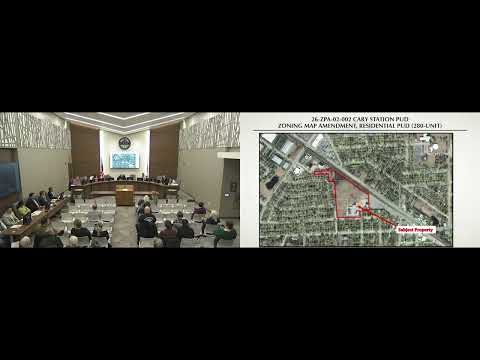
The Zoning, Planning & Appeals board voted 4–2 to recommend rezoning and Planned Unit Development approval for the 280‑unit Cary Station project at the former Maplewood School site, despite sustained public opposition over parking, flood risk, density and spot‑zoning; the matter moves to the Village Board on June 2.
The Village of Cary Zoning, Planning & Appeals (ZPA) voted 4–2 to recommend approval of the Cary Station Planned Unit Development (PUD) and a map amendment for the former Maplewood School site at 422 Krenz Avenue, a developer and staff presentation and more than two hours of public comment concluded. The board’s recommendation now goes to the Village Board on June 2.
Planner Simmons told the board the petitioner seeks to rezone the roughly 15‑acre site to PO (Park & Open Space) for the park parcel and B1 (Central Business District) for the balance of the site, and to approve a PUD for 280 residential units with six departures from the Unified Development Ordinance, including reduced building separations, a partial increase in height for two northern buildings and a reduction in off‑street parking for the multifamily portion.
The developer’s presentation, led by Brian Kronwitter, principal with Kortig & Clark, and Michael Polakaddis of JM Developers, described a mixed plan of detached single‑family homes, duplexes, townhomes and three multifamily buildings arranged to step up in height toward the railroad corridor and a future High Road extension. Kronwitter said the proposal includes a neighborhood park, a pool and internal pedestrian routes and that about 40 percent of the site would remain “green” in design. “We believe what we are presenting tonight meets those objectives,” he said.
Developers and third‑party consultants also presented market, financial and fiscal‑impact analyses. Michael Polakaddis cited a third‑party study projecting roughly $101 million in private construction investment, about 531 new residents, and an estimated $11 million in village revenue over the next 10 years from impact fees and sales taxes. The team said the multifamily portion would provide about 350 parking spaces (215 surface + 135 in first‑level parking) and requested a departure from the code’s 2.25 spaces per unit to reach roughly 1.5 spaces per unit for the apartment component.
Residents who spoke during the public‑comment period voiced consistent concerns. Robin Ankles, a longtime Frankie Subdivision resident, said the plan would damage neighborhood character and property values and asked whether the village would compensate homeowners if values fell. “This is trash,” Ankles said. Other speakers, including Kurt Zimmerman and multiple neighbors, raised worries about parking overflow onto neighborhood streets, stormwater and flooding in a low‑lying portion of the village, fire safety with closer building separations, and legal risks from what several residents called spot zoning.
Engineer Brian Johnson of Pinnacle Engineering said the design includes three dry stormwater detention basins sized to meet county ordinance and explained connections to existing sanitary and water infrastructure. “These ponds are sized based on the local and county stormwater ordinance,” Johnson said, adding the proposed infrastructure reductions should not increase peak runoff under the proposed controls.
Staff recommended approval subject to the conditions in the staff report; after brief board questions and a motion the ZPA recorded a roll‑call vote: O'Laughlin (no), Williams (yes), Kretschmer (yes), Trandell (yes), Castetter (yes) and Graziano (no). On that 4–2 vote the ZPA recommended rezoning to PO and B1 and approval of the Cary Station PUD to the Village Board, which is scheduled to consider the matter on June 2.
At the meeting’s close the board chairman reminded attendees that staff had compiled 18 conditions in the staff report that, if approved later by the Village Board, would shape final engineering and design details.
Next steps: the Village Board public hearing and vote are set for June 2; if approved there, the terms of the redevelopment agreement, infrastructure funding and any required regulatory permits will guide implementation.