Get Full Government Meeting Transcripts, Videos, & Alerts Forever!
Get email alerts on the Healthcare 340b topic
No spam. Unsubscribe anytime.
Minnesota Senate approves bill to strengthen enforcement of 340B drug discounts, removes sunset
Summary
The Minnesota Senate on April 7, 2026, passed Senate File 3769 to bolster enforcement of state 340B protections and remove a sunset on the 2024 law. Lawmakers debated competing amendments on transparency, patient pricing and enforcement; several amendments failed before final passage was recorded 42–24.
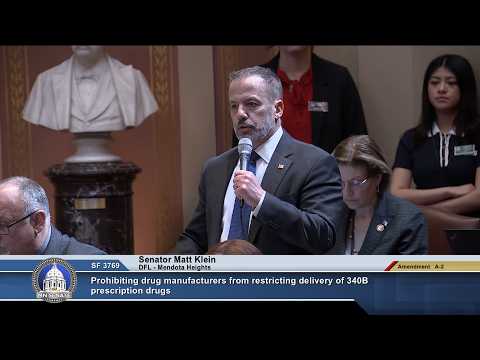
The Minnesota Senate passed Senate File 3769 on April 7, 2026, advancing a measure to strengthen enforcement of the state’s 340B drug-discount protections and remove a sunset date enacted in 2024. The final roll call recorded the bill as passed, 42 yeas to 24 nays.
Sen. Klein, the bill’s sponsor, told colleagues the legislation is intended to protect rural hospitals, safety-net providers and pharmacies that rely on 340B savings to keep services open. "This is a David versus Goliath bill," Sen. Klein said, urging enforcement tools be added so manufacturers cannot "ignore Minnesota law." He said the bill does not change the federal 340B program but creates state mechanisms to compel compliance.
Opponents and some amendment sponsors said the underlying federal program and the role of manufacturers, payers and hospitals are complex and that the bill raised unresolved questions. Sen. Rasmusson offered a suite of amendments intended to add reporting, program-integrity checks and direct protections for uninsured and high-deductible patients. He argued the Department of Health’s report showed about $1.3 billion in 340B revenue for covered entities and said Minnesotans should "know where these dollars are going." He asked senators to prioritize patients who "are paying $5,000 or $10,000 deductibles."
Several of Sen. Rasmusson’s proposed changes were rejected by the Senate. An amendment to add transparency and program-integrity provisions (A2) failed on a roll call after supporters warned it would impose new fiscal and data burdens; proponents said it was needed to ensure funds reached patients. A separate amendment (A5) that would have barred 340B entities from charging uninsured patients or people with high-deductible plans more than the program cost was also rejected; the A5 amendment was recorded as 32 yeas and 34 nays.
Debate repeatedly returned to two themes: whether adding state enforcement would induce manufacturer compliance without undue cost or privacy risk, and whether limiting how hospitals use 340B revenue would jeopardize rural and critical-access hospitals. Sen. Klein and other proponents said state enforcement has worked in other states and would protect access to care across Greater Minnesota. Several senators pressed the fiscal assumptions behind the attorney general’s enforcement costs, questioning whether a first-year cost estimate in the fiscal note was sufficient if litigation against multiple manufacturers proceeded.
The Senate also considered amendments on facility fees (A3) and a proposal to restrict use of 340B funds for certain gender-affirming surgeries (A4). A procedural appeal related to germaneness (connected to A3) was decided in favor of the chair. The transcript records debate over A4 but does not show a floor vote on that amendment in the provided segments.
Throughout debate senators invoked the Minnesota Department of Health report and a patchwork of examples showing different covered entities use 340B revenues differently — for charity care at some hospitals and as broader revenue at others. Supporters argued the bill removes uncertainty for hospitals planning budgets and preserves services; critics urged more study and clearer fiscal modeling before broad changes.
The Senate concluded its business and adjourned. The record in this session shows SF 3769 passed the Senate; the transcript records the final roll call as 42 yeas and 24 nays.
The Senate debate included sustained exchanges over enforcement authority, transparency and patient protections. Senators on both sides said they wanted to keep hospitals open and patients protected, but they differed on whether this bill, as amended on the floor, was the correct balance of tools and safeguards.