Get Full Government Meeting Transcripts, Videos, & Alerts Forever!
Get email alerts on the Labor Contracts topic
No spam. Unsubscribe anytime.
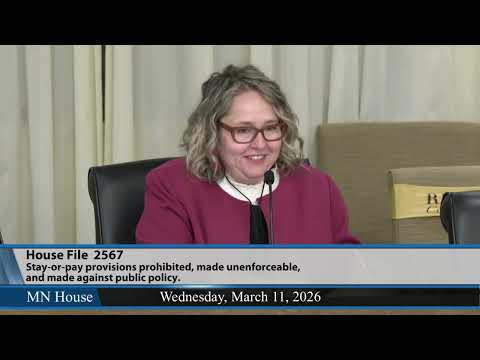
Committee deadlocks on bill that would ban 'stay-or-pay' training repayment clauses
Summary
A House committee heard testimony from workers and businesses on House File 2567, which would bar employer 'training repayment' or 'stay-or-pay' clauses; members split 7-7 and the motion to advance the bill failed. Supporters described large repayment demands; business groups warned of unintended consequences.
Chair Dave Pinto opened debate on House File 2567, a bill that would prohibit employer clauses that require departing employees to repay training costs (commonly called "stay-or-pay" or training repayment agreements). The sponsor said the provisions trap workers, citing examples such as cosmetology or nurse training and asserting that the clauses diminish worker mobility and bargaining power.
Several workers testified that they were required to sign repayment agreements and later billed large sums. Hannah Ford said she paid for state certification as an eyelash technician and then, after starting a job, was told she owed $3,000 for training she said she did not receive. A remote witness identified as Chris Sex, a senior policy advisor at a borrower-rights nonprofit, testified that such agreements limit mobility and that national investigations and litigation have spotlighted the practice.
Business groups, including a representative of the Minnesota Chamber of Commerce and Don Davis of the Minnesota Business Partnership, opposed a blanket prohibition. They said repayment agreements encompass relocation assistance, tuition reimbursement, sign-on or retention bonuses and other employer investments; they warned that banning the agreements could lead employers to stop offering such programs.
The sponsor described two amendments intended to create exceptions for credentialed training programs, registered apprenticeships and tuition repayment tied to transferable credentials, and said the amendments align enforcement with existing restrictive-covenant law and remove a fiscal note. Committee members questioned how "transferable credential" will be defined and whether the bill could unintentionally cover military or National Guard training obligations.
After discussion and roll-call, the committee reported a 7-7 tie on the motion to advance the bill, and the motion did not prevail; HF2567 did not move forward at this hearing.
The committee indicated interest in clarifying definitions and exceptions before any further action.