Get Full Government Meeting Transcripts, Videos, & Alerts Forever!
Get email alerts on the Ndas Transparency topic
No spam. Unsubscribe anytime.
Committee advances bill to bar local governments from signing NDAs with private developers
Summary
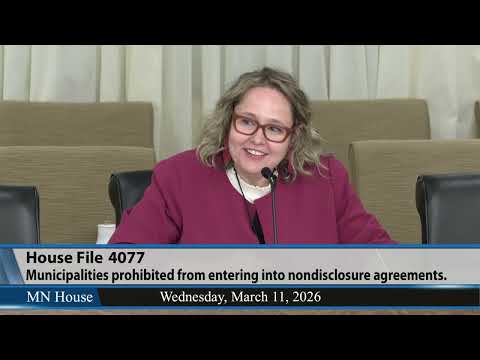
A House committee advanced House File 4077 after testimony from residents and county officials who said nondisclosure agreements have hidden major data-center proposals and eroded public trust; the measure was amended to focus on economic-development and property-acquisition deals and referred to the General Register.
Representative Greene introduced House File 4077 as a measure to prohibit local governments and their officials from entering into nondisclosure agreements with private entities on certain economic-development, land-use and property-acquisition projects. Greene said the bill is narrowly aimed at preserving the public’s right to know about decisions that affect communities and does not change existing public-records or open-meeting protections.
Supporters who testified described multiple Minnesota communities where NDAs, they said, delayed public notice and limited residents’ ability to weigh in on large projects. “We didn’t find out that Google was behind this until the Star Tribune reported it,” said Richard Hilton, a Hermantown resident, who told the committee an NDA concealed a rezone and a proposed data center until after votes had already occurred. Abby Dixon, who identified herself as a Pine Island resident, urged the committee to extend the ban to contracted municipal employees after she said residents learned only through public-record requests that NDAs had been signed.
Kathie Johnson of Farmington said developers used boilerplate agreements and sought exceptions to ordinances and height limits while keeping substantive details from the public. Sarah Meridian, government-relations director for CURE, said public-records requests show NDAs routinely delay disclosure across cities such as Hermantown, Farmington, Monticello and North Mankato and cited reporting that land values rose sharply when projects were sold, a dynamic she said favors well-funded developers over community oversight.
County officials and volunteers also urged action. Ashley Grams, a St. Louis County commissioner, said NDAs had allowed companies years of behind-the-scenes access and argued a statewide standard is needed so jurisdictions are not undercut by neighboring local governments. Nathan Ryan, an elected official with ties to Dundas and Farmington, read language from a developer agreement he said would effectively lock local official controls for eight years.
The committee adopted an office amendment (A1) to expand the bill’s covered jurisdictions and to clarify that NDAs with private parties include corporations and other entities. Members then adopted a second amendment to focus the bill on projects that were wholly or partly publicly funded or tied to tax increments, bonds or other public financial obligations. During member questions, Representative Greene said the measure does not alter Chapter 13 public-data exemptions or trade-secret protections, and that the amendments were intended to narrow the bill’s scope to economic-development and property transactions.
After debate, Representative Greene’s motion to refer the bill to the General Register was approved by voice vote. The committee packet included both in-person and remote testimony and written materials documenting local cases where residents said NDAs limited timely public review.
The bill’s next step is the General Register; committee members signaled interest in considering a companion measure to apply similar restrictions at the state level.