Get Full Government Meeting Transcripts, Videos, & Alerts Forever!
Get email alerts on the Electric Vehicle Fuel Tax topic
No spam. Unsubscribe anytime.
Senate panel reviews working-group plan to tax electricity as vehicle fuel; A1 amendment accepted and bill tabled
Summary
The Minnesota Senate Transportation Committee heard a working-group final report and a bill (Senate File 4169) that would treat electricity sold for vehicle charging as a taxable vehicle fuel, indexing the excise, defining 'retail' charging, moving remittance to quarterly and exempting sales tax to avoid double taxation; the committee adopted an A1 technical amendment and laid the bill on the table for further work.
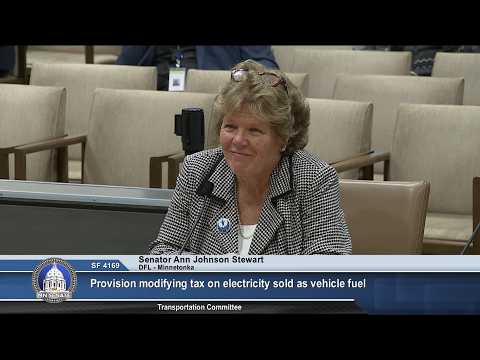
Sen. Johnson Stewart, chair of the working group, presented a final report to the Senate Transportation Committee on March 11, outlining recommendations to treat electricity sold for vehicle charging as a taxable vehicle fuel and to align revenue collection more closely with gasoline taxes. The committee accepted an author’s A1 amendment to align effective dates with prior legislation and laid the bill on the table for further study and coordination with other committees.
The recommendations in the working-group report and the text of Senate File 4169 center on several changes: adopting a uniform definition for taxed stations (the report proposes using the term 'retail' to mean facilities that charge a fee and are open to the general public), expanding the excise to Level II and Level III retail chargers, moving remittance of the public-charging excise from monthly to quarterly, indexing the excise to inflation (capped at 3% per year), exempting electricity sold as vehicle fuel from sales and use taxes to avoid double taxation, and exempting certain federal uses/contractors. The bill also includes an unspecified appropriation to the commissioner of transportation for administrative and matching federal aid purposes; the committee has requested a fiscal note.
Supporters said the changes would help preserve funding for roads and bridges as vehicle fleets electrify. "The number of electric and hybrid and all-electric vehicles purchased in the state has grown from about 1,000 registered in 2019 up to 14,800 in 2024," said Margaret Donohoe, executive director of the Minnesota Transportation Alliance, arguing that indexed fees and investment in charging infrastructure are needed to sustain highway funding.
Opponents and some stakeholders raised equity and implementation concerns. Brendan Jordan of Drive Electric Minnesota said the combined effect of registration surcharges and a public-charging excise could fall disproportionately on renters and lower-income drivers who rely on public chargers: "By our calculation it could be $500 a year on top of the tab fees," he said, urging that the state consider a flat fee or an opt-in mileage-based road-user charge instead. A Fresh Energy transportation policy representative also urged repeal of the public-charging tax expansion and recommended a holistic rethinking of how roadway funding treats all vehicle types.
Committee members questioned practical details that remain unresolved: whether and how small or amenity chargers (for example at hotels or office buildings) would be licensed or treated as 'retail,' how the state will identify taxable charging locations, and whether metering/home-charging taxation is currently feasible (the working group concluded the technology to meter home charging for excise purposes is not yet broadly implementable). Sen. Johnson Stewart noted the group recommended revisiting the approach in five years as technology and usage patterns change.
The committee accepted an A1 author’s amendment, described as technical language to align effective dates with prior statute and move implementation timing into alignment with the 2027 start date in last year’s law. On the amendment the chair called for voice votes; the motion "carried," and the amendment was incorporated. Rather than advancing to final passage, the committee elected to lay Senate File 4169 on the table to allow time for a fiscal note, agency implementation planning, and further intercommittee coordination.
Next steps: the bill remains pending; the committee requested a fiscal note and indicated additional conversations will occur with the taxes committee and state agencies about implementation, equity mitigations, and administrative burdens. If the committee revives the bill, members said they expect additional technical fixes and clarifications about licensing, reporting, and distribution of any revenue dedicated to highway funds.