Get Full Government Meeting Transcripts, Videos, & Alerts Forever!
Get email alerts on the Electronic Tagging LD 2217 topic
No spam. Unsubscribe anytime.
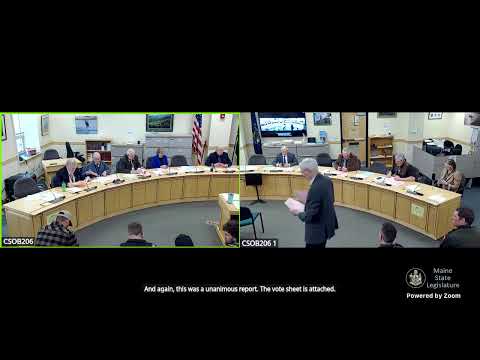
Committee rejects bill to require electronic deer tagging after debate on fees and data collection
Summary
The committee debated LD 2217, which would permit electronic tagging of deer and remove per‑animal registration fees, and considered an amendment to offset lost revenue by raising certain big‑game license fees and adding enforcement penalties. The committee voted 4–5 against the amended bill.
The Inland Fisheries & Wildlife Committee considered LD 2217, a bill that would direct the department to allow electronic tagging/registration of deer beginning in 2027 and would eliminate registration (seal) fees for deer, bear, moose and wild turkey.
Ann Davidson, the committee analyst, summarized the bill and the March 2 public hearing: the sponsor (Senator Bachi) and a member of the public supported electronic registration; Maine Woodland Owners opposed because eliminating registration fees would remove more than $250,000 per year that helps fund the deer management assistance program; IF&W testified neither for nor against and proposed several implementation options and amendments.
Dr. Web (department director) told the committee that removing the per‑animal registration fee would shift the cost burden to license fees but cautioned that requiring a credit‑card transaction at the moment of self‑registration would complicate the online experience and might deter users. The department estimated additional annual costs of roughly $45,000 for expanded technical support and for increased biological data collection if hunter contact is needed to obtain samples currently gathered at registration stations. “It does add quite a bit of complexity to the interface that hunters would interact with,” Dr. Web said of charging at the self‑registration step.
Representative Kluchi circulated an amendment the department drafted to restore funding for the deer management program by increasing specific resident and nonresident big‑game license fees (examples in the amendment: +$2 for certain resident big‑game licenses and +$4 for certain nonresident big‑game licenses) and to remove opposition from Maine Woodland Owners. The amendment also contemplated language on enforcement; IF&W recommended a mandatory one‑year license revocation for failure to register or false registration as a disincentive.
Committee members raised several concerns: the potential for increased unreported harvests, the voluntary nature of house‑to‑house biological sampling, the cultural importance of in‑person tagging stations to rural communities and small businesses, the effect on lifetime license holders who cannot be charged retroactively, and whether license fee increases would affect federal Pittman‑Robertson matching formulas. Department leaders responded that other New England states have implemented electronic registration without clear spikes in non‑reporting, that stations would continue to be available and paid $2 per in‑person registration under the amendment, and that the department could report back in a defined period to assess whether biological sampling and compliance are adequate.
Representative Bill Bridgio moved to pass LD 2217 as amended by Representative Kluchi, to add enforcement language and to include a report‑back. After debate the committee took a roll call. The transcript records the final tally as four in favor and five opposed; the motion failed and LD 2217 did not move forward from the committee.
Key implementation figures cited in the hearing included a department estimate that eliminating registration fees would reduce revenue by more than $250,000 per year (the $5 per registered deer currently includes $2 to the deer management fund) and an internal estimate of about $45,000 per year for added technical support and extra biodata collection.
Next steps: the failed motion means the committee did not advance LD 2217. Several members asked that future proposals include explicit enforcement mechanisms and a return report after implementation to measure biological data outcomes and compliance.