Get Full Government Meeting Transcripts, Videos, & Alerts Forever!
Get email alerts on the Data Centers topic
No spam. Unsubscribe anytime.
San Marcos residents press council over proposed Francis Harris Lane data center; council approves annexation but map change fails
Summary
Hundreds of residents packed the San Marcos council chamber to oppose a developer’s request to rezone Francis Harris Lane for a large data center; council approved annexation of the property but failed to pass the preferred‑scenario map amendment required for the light‑industrial zoning after weeks of testimony and unresolved technical questions on water, power and enforceability of covenants.
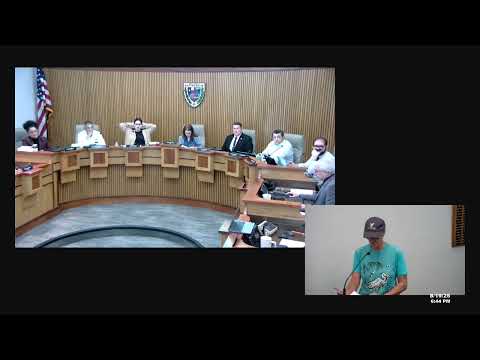
Hundreds of residents, union representatives and company attorneys filled city hall on Aug. 19 as the San Marcos City Council heard hours of public comment on a proposed data‑center project and related annexation and zoning requests for property on Francis Harris Lane.
The annexation — adding about 64 acres to the city so the applicant could pursue city‑level regulation — passed on a 7–0 vote after the council closed a lengthy public hearing that included dozens of speakers for and against the project. Opponents urged the council to delay and demand hard numbers on water, energy use and enforceable, perpetual protections; supporters pointed to potential tax revenue and union construction jobs.
Why it matters: the annexation would allow the city to apply its own development standards — including the restrictive covenant the applicant has offered — rather than leaving future permitting to county rules. Speakers on both sides argued the choice would shape the watershed’s long‑term water budget, neighborhood quality of life and local fiscal capacity.
At the heart of the debate were a set of draft restrictive covenants the applicant provided during the recent review process. Attorney Michael Whan, speaking for the applicant, described the written commitments the developer had offered: a closed‑loop, non‑evaporative cooling system, a daily water allocation capped at 75,000 gallons (a figure the applicant characterized as substantially less than the existing entitlement for a proposed 550‑home subdivision), limits on impervious cover and water‑quality requirements, and a daytime noise cap tied to city code. "The water that was going to be used for development is dramatically reduced," said developer John Mayberry, citing the covenant numbers and the project’s five building layout.
Residents countered that the city needed more than written promises. "Their presentation was vague. They refused to commit to numbers," said Sean Jones, one of the night’s earliest public commenters. Several speakers pressed staff and the applicant for: (1) a permanent — not 20‑year — covenant, (2) verified, unitized kWh and daily water use figures for the site, (3) proven enforcement mechanisms and clawbacks if covenants are broken, and (4) independent monitoring and public reporting of water and noise measurements.
Assistant City Manager Joe Pantalion and Planning Director Amanda Hernandez walked the council through staff analysis of the planning, noise and water issues, noting the difference between closed‑loop cooling (which does not evaporate process water onsite) and older evaporative systems. Pantalion cautioned that, whether built inside city limits or outside it, any large new data center will pull grid power and that the water used to produce that power occurs elsewhere on the system. "Data centers are placed in a queue for approval as power and transmission capacity or system upgrades are identified," he said, urging attention to regional energy planning and utility coordination.
Council action and next steps: Council approved only the annexation portion of the request. The preferred‑scenario map amendment — the change in the city’s long‑range land‑use map that would allow light‑industrial zoning on the parcels — failed to secure the supermajority vote required to overturn Planning & Zoning Commission’s denial. Because the map amendment failed, the related zoning item could not be considered.
What the advocates wanted: the applicant and supporters argued a city‑regulated project that includes binding covenants is preferable to the county alternative, where the city would have little regulatory leverage. "If we don't get this zoning, the power will pass to the next in line," John Mayberry told the council, urging the city to secure enforceable protections as part of any annexation.
What opponents stand to gain: residents want stronger, permanent guarantees — including clearer enforcement steps, public reporting of monthly water and energy usage and independent monitoring — before they will accept a major industrial use adjacent to a working power plant and active watershed.
Where it stands: The council directed staff to continue negotiations and to return materials for the required public hearings and technical follow‑up. Cyrus One — an operator repeatedly named during testimony — issued a statement saying it had paused active involvement in the rezoning process to address community concerns; the annexation remains in place pending any future applications. The matter is expected to return to public hearing if the applicant revises and resubmits the map and zoning requests.