Get Full Government Meeting Transcripts, Videos, & Alerts Forever!
Get email alerts on the Ai Governance topic
No spam. Unsubscribe anytime.
Guam launches Artificial Intelligence Regulatory Task Force; leaders stress workforce preparation and ethics
Summary
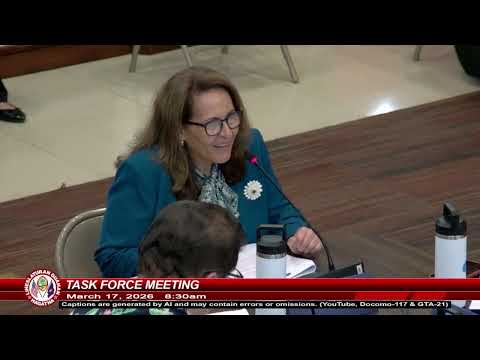
The Guam Artificial Intelligence Regulatory Task Force held its inaugural meeting to organize seven subcommittees, accept startup funding and NCSL support, adopt an official logo, and set meeting and reporting expectations; the lieutenant governor urged preparation for AI-related workforce changes.
The Guam Artificial Intelligence Regulatory Task Force held its inaugural meeting to organize subcommittees, accept startup support and outside advice, and set rules for how the group will operate going forward. The meeting opened with a written message from Lieutenant Governor Joshua Tenorio urging the territory to prepare residents for AI-driven changes in the labor market and to adopt policies that protect privacy and fairness.
"AI itself will not take jobs, but people who know how to use AI effectively will increasingly compete for them," Lieutenant Governor Joshua Tenorio wrote in a message read at the meeting, urging investment in education and policy. Tenorio cited both the scale of expected labor-market change and the need for transparency in systems that affect healthcare, education and public safety.
Heather Morton, director of finance, service, technology and communication at the National Conference of State Legislatures (NCSL), gave an overview of NCSL resources and offered the group's AI policy toolkit and state-tracking research as references for Guam's task force work. "Our AI policy toolkit is designed to be a one-stop roadmap," Morton said, and she confirmed materials and slide links would be shared with task force staff.
Senator Tydingco, chair of the task force, oversaw the creation of seven subcommittees covering cybersecurity and data privacy; U.S. and international policy; workplace integration; education and social media; human resources and predictive policing; ethics and deepfakes; and penalties, fines and enforcement of AI-related crimes. Subcommittee chairs and membership lists were read into the record and then ratified without objection.
Bea Santos of the Office of Technology was named chair of the Cybersecurity and Data Privacy Protection subcommittee. Esther Aguigui was named chair of the U.S. and international AI policies, guidelines and infrastructure subcommittee. Other chairs include David Dela Sola for human resources and predictive policing, Jean Crisostomo for ethics and deepfakes, Anita Enriques Borja for education and social media, and Mia Bonardi for penalties and enforcement; Matthew Baza served as proxy for Christina Garcia on the workplace integration subcommittee.
The chair announced that the task force comes with initial funding and affirmed reporting expectations established by the enabling statute. Chairs must present subcommittee activity at each full task force meeting; subcommittees are expected to meet at least monthly and, where practical, record sessions for proxy members to review. The full task force will meet every other month.
Members adopted an official task force logo following a reported internal vote in favor, and the chair declared it the official emblem. The chair also called for any objections to the list of subcommittee chairs; hearing none, she ratified the roster.
Participants discussed meeting logistics and access, with many members favoring virtual meetings to support attendance and continuity. Nathan Tenneson of the Judiciary suggested using AI tools to generate summaries of subcommittee meetings to aid documentation and posterity.
Medical leaders noted local pilots: Dr. Jolene Aguon from Guam Memorial Hospital Authority reported the hospital has been piloting AI at the bedside to improve efficiency and patient care processes, and she expressed support for task force efforts to provide guidance and oversight.
The meeting closed after a motion to adjourn; the chair declared the meeting adjourned at 9:20 a.m. The task force will use the NCSL resources shared and return to scheduled meetings with subcommittees convening to begin detailed policy work.
Ending: Task force chairs were directed to convene monthly, prepare reports for the full task force, and begin work on transparency, privacy, and workforce recommendations required under Public Law 38-77.