Get Full Government Meeting Transcripts, Videos, & Alerts Forever!
Get email alerts on the Municipal Budget topic
No spam. Unsubscribe anytime.
Wyoming officials outline FY27 budget, plan large ERP investment and modest water/sewer rate increase
Summary
At its April 13 work session the council reviewed the FY27 budget framework: an ERP system investment is planned, water/sewer rates would rise from an average $180 to $195 per quarter, a public hearing is scheduled for May 4, and charter-required adoption is set for May 18.
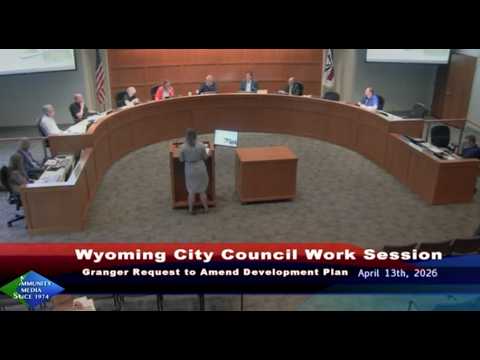
City staff presented the proposed FY27 budget framework at the Wyoming City Council work session on April 13, outlining timelines, major investments and projected revenue impacts.
Jody (staff) said the fiscal year begins July 1, the public hearing on the proposed budget is set for May 4, and the council must adopt a final budget at its May 18 meeting to comply with the city charter.
Key items called out in the presentation included a large planned investment in a new enterprise resource planning (ERP) system to replace the city’s 20‑year‑old financial system and several capital projects for water and sewer infrastructure. Staff described the ERP as a multiyear, high‑cost project that will be budgeted and executed over multiple years and said consultants are engaged to write the RFP.
Staff also summarized proposed water and sewer rate adjustments recommended by Stantec’s rate model. Officials said the average residential quarterly water/sewer bill would rise from about $180 to $195 — an increase of approximately $15 per quarter, or $5 per month — to help fund system maintenance and upcoming capital work. Wholesale customers would be charged according to formulas in their contracts.
On property tax revenue and millages, staff explained Headlee rollback mechanics and noted the city’s taxable value has exceeded $3 billion; fiscal‑year projections presented by staff showed tax revenue of about $42 million aggregated across restricted millage buckets. The state‑set inflation cap used in calculations was cited as 2.71% for the year, which affects levy capacity and triggers potential rollbacks.
Fund‑level summaries showed roughly $157 million in proposed revenues and $153 million in expenditures across all funds, with the general fund just under $44 million and public safety budgets accounting for a significant share. Staff said the general fund would transfer funds to public safety and to the Capital Projects Revolving Fund this year, including a one‑time larger contribution (about $5.3 million) allocated to the ERP project.
Council members asked clarifying questions about vehicle replacement planning, sidewalk and street funding, and how rate increases relate to capital projects in upcoming years. Staff said many rate and capital decisions are driven by multi‑year capital improvement plans and recommended smoothing increases where possible to meet future obligations.
What happens next: staff will update the budget book as requested and publish materials ahead of the May 4 public hearing; council is scheduled to adopt the budget by May 18 per charter requirement.