Get Full Government Meeting Transcripts, Videos, & Alerts Forever!
Get email alerts on the Surveillance Reform topic
No spam. Unsubscribe anytime.
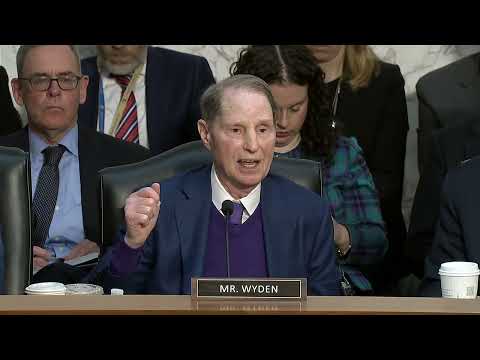
Sen. Wyden warns 2024 reauthorization provision could be "dangerously broad" in surveillance powers
Summary
Sen. Wyden told the Senate Committee on Finance that a provision added to the 2024 reauthorization expanding who can be compelled to assist foreign-intelligence collection is "dangerously broad," and pressed witnesses for evidence of intelligence value; Gen. Hartman said the provision applies to collecting intelligence on foreigners outside the U.S. and deferred operational specifics to closed session.
Sen. Wyden pressed intelligence officials at a Senate Committee on Finance hearing about a section of the 2024 reauthorization that he said expanded which companies and individuals could be compelled to assist in foreign-intelligence collection. He called the provision "dangerously broad," arguing it could be used to target anyone with access to a cable box, Wi‑Fi router or server and said it had been "jammed into the 2024 reauthorization bill at the last minute." Wyden cited testimony from a witness who told the committee the provision so far "has had no value."
Gen. Hartman responded that the provision "provided us no additional authority that does not involve collecting intelligence on foreigners that are outside of the United States of America," and asked to discuss operational specifics in closed session. Hartman’s remarks emphasized, in his view, limits on the provision’s reach but did not address the examples Wyden raised in open session.
Wyden said the exchange should serve as a warning to other senators and noted the committee was preparing another discussion on the matter. The senator framed the exchange as part of a larger push for surveillance oversight and cautioned that not every expansion of spying power marketed as urgent is actually necessary.
Why it matters: The dispute centers on whether a statutory expansion added during the 2024 reauthorization meaningfully broadened the government’s ability to compel assistance from private parties — and whether that authority has produced operational value to justify the tradeoff for privacy. The committee’s next steps, according to Wyden, will include further hearings and review in closed session on classified details.
The hearing transcript shows a clear separation between Wyden’s policy and civil‑liberties concerns raised in open session and Hartman’s choice to limit sensitive operational discussion to closed session. The committee did not vote on or adopt any formal changes during the excerpted exchange.