Get Full Government Meeting Transcripts, Videos, & Alerts Forever!
Get email alerts on the Municipal Budget topic
No spam. Unsubscribe anytime.
Philadelphia council presses L&I commissioners on staffing, nuisance enforcement and new rental-inspection rollout
Summary
City Council questioned L&I commissioners about inspector vacancies, enforcement of nuisance businesses and plans to scale a proactive rental-inspection program; commissioners defended recent enforcement gains, outlined recruitment and training plans, and set a 5-day target for urgent license-reinspection escalations.
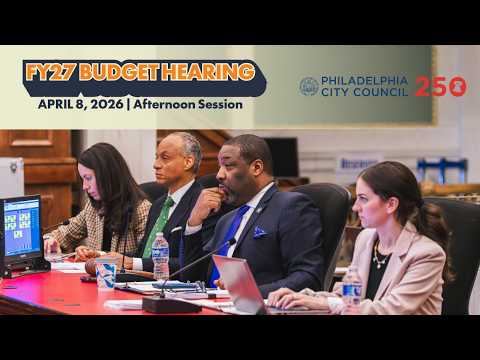
Bridget Collins Greenwald, commissioner of the Department of License and Inspections’ Quality of Life division, and Basil Miranda, commissioner for License and Inspections’ Inspection, Safety and Compliance division, defended the department’s FY27 staffing and enforcement plans at a Committee of the Whole hearing on the city’s proposed budget.
The hearing, convened by Council President Johnson, focused on how L&I will staff a recently announced proactive rental-inspection program, tighten enforcement against chronic nuisance businesses and follow up on vacant-property cases. Greenwald told the panel she supports L&I’s FY27 request and highlighted the division’s neighborhood education and enforcement work. Miranda outlined four ISC initiatives: an audits and investigations unit that pursues alter-ego contractor schemes, enforcement of a 2006 construction-code provision that allows denial of permits and license renewals for contractors owing fines, a nationally recognized remote-inspection unit, and the addition of seven inspector recruits that lowered ISC’s vacancy rate.
Why staffing matters: Council members repeatedly pressed L&I on vacancies and the time it takes to certify new inspectors. Greenwald said the Quality of Life side is at about a 5% vacancy rate after recent hiring and expected four more inspectors to start the following week; she noted QOL inspectors require less trade-specific certification than construction inspectors. Miranda said ISC has been operating near a 20% vacancy rate and pointed to state-required certification timelines that can take four to 12 months. Both commissioners described short-term strategies—use of strategic overtime, district-based staffing and targeted hires—to keep inspections moving while training proceeds.
“We just hired eight inspectors. We have four more starting next Monday, and that will get us to only having one inspector vacancy,” Greenwald said. Miranda described the new training syllabus for recruits, which includes college-level construction coursework, report writing and earlier district placement to speed practical experience.
Enforcement gains and limits: Miranda described recent legal tools and enforcement changes that L&I says strengthen its ability to hold bad actors accountable. He said the audits unit produced an order from the L&I Board of Review allowing the revocation of a contractor’s license and stop-work orders for associated projects, and L&I has begun enforcing a 2006 construction-code provision that permits denying permit issuance or license renewal for contractors who owe fines.
The department also reported 43 active chronic nuisance cases and about 448 total nuisance-related files, and said coordination with the Police Department has improved the response to businesses that generate repeated complaints. Under the city’s chronic-nuisance path, the Police Department may issue three civil violation notices within 12 months; an intent-to-cease is then sent to L&I, the business must meet the district captain to sign a nuisance-abatement agreement, and police are the primary enforcer of cease operations. L&I officials said if a business reopens after a posted cease, the case can be processed to court and the licensing consequences can follow.
Council members pressed L&I for clearer rules about which cases move from L&I to the Law Department for court action. L&I described a court-flow process (inspection, reinspection, second reinspection and then referral) but said the Law Department makes the final decision about which cases it will pursue. Council members asked for a joint meeting with L&I and the Law Department to clarify referral criteria and suggested improved district-level reporting.
Proactive rental inspections and legal backing: Council members praised the stand-up of a proactive rental-inspection pilot and said it will only reach its potential if the city enacts enforcement measures—cited in testimony as the Safe Healthy Homes Act—that create clear, enforceable consequences for landlords who fail to repair hazardous conditions. Greenwald described plans to expand the inspection team: eight new inspectors on top of five current inspectors (for a total of 13 inspectors), a director, two supervisors, a code administrator to identify unlicensed rentals through data, and a service representative to coordinate cases.
Greenwald said L&I aims to keep urgent license-renewal escalations moving and described an internal escalation pathway: "If someone is caught in this system... we would ensure that we will get back out there if it's holding up someone from getting their license," she said, adding the department typically targets about a five-day turnaround for escalated renewal inspections.
Data and discovery: Council members asked how L&I will identify unlicensed landlords and properties. Greenwald said L&I is building a data-driven approach—using its Eclipse permitting system and partnerships with Revenue, Philly 360 research teams and OIT—to cross-reference meters, municipal filings and other indicators. She committed to working with Revenue and others on data-sharing and to creating a code-administrator role focused on finding unlicensed units.
Community evidence and the role of 311: Council members and commissioners urged residents to document complaints. Miranda said neighbor 311 complaints with photos help build the proofs L&I needs for stronger enforcement or audit follow-ups. Commissioners also described Saturday patrols and clean-site initiatives to deter off-hours illegal activity.
What’s next: Commissioners asked Council for continued budget support for staff and technology as L&I scales inspections and enforcement. The committee recessed on a voice vote and will reconvene Tuesday, April 14, 2026, at 10:00 a.m.