Get Full Government Meeting Transcripts, Videos, & Alerts Forever!
Get email alerts on the Traffic Calming topic
No spam. Unsubscribe anytime.
Metro traffic staff unveil final Takcoa Street traffic‑calming plans; mail ballots to neighbors
Summary
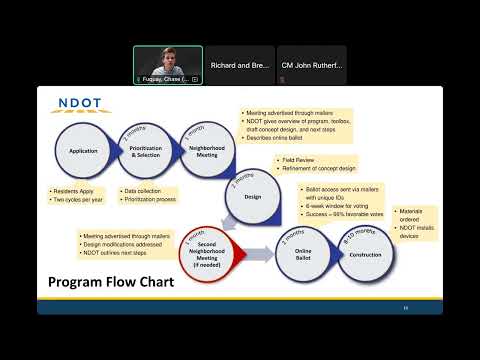
Metro traffic staff presented final plans for Takcoa Street featuring speed cushions and two radar speed‑feedback signs, and said mail ballots with unique IDs will be sent to affected property owners for a six‑week vote that requires two‑thirds of respondents to approve the project.
Metro traffic staff presented draft final designs for Takcoa Street on a second neighborhood meeting, detailing speed cushions and radar speed‑feedback signs and explaining that ballots will be mailed to affected properties for a six‑week vote.
The presenter said Takcoa Street — selected in the fall batch of the traffic calming program — was advanced after field measurements and neighborhood feedback. Staff emphasized the program’s focus on engineering solutions to reduce speed as part of broader Vision Zero goals and noted that the program has received more than 700 applications (staff estimate, as stated in the meeting) with about 25 streets selected each cycle.
Staff said the primary treatment proposed for Takcoa Street is speed cushions, supplemented where cushion placement is constrained by steep grades, driveways or intersections with radar speed‑feedback signs. "Yes, there will be a sign on facing both directions," a Metro traffic staff member said when asked about signage for cushions.
The plan overview identified existing cushions near Oakfield Road that overlap the project limits and showed proposed new cushions between Chinook and Centila in front of 7445 and an additional cushion grouping near 7416. Staff said two cushion configurations (A and B) are included to accommodate narrower and wider street sections — some locations will have two cushions, others three — and the design places radar signs where steep slopes preclude cushions.
On next steps, staff said final zone plans will be posted on the program website and that mail ballots with unique IDs will be sent to parcels within the project limits. Ballots will be open for six weeks; staff said the measure requires two‑thirds of respondents to vote yes for the project to move forward. Staff also explained voter eligibility: each parcel within the limits receives one vote (including churches and schools), owners of multiple properties receive one vote, vacant parcels and HOA‑owned parcels are ineligible, and businesses within the zone are eligible to vote.
An attendee asked whether there is a minimum number of respondents required for the tally; staff said they do not believe there is a separate respondent threshold beyond the two‑thirds yes requirement of respondents who return ballots. Staff urged residents who expected a ballot but do not receive one to contact project staff and provided a QR code and contact information.
A nearby resident raised a safety concern about visibility of newly installed cushions in heavy rain, saying the cushions were "brand new and it was very difficult to see them" without reflective signage and asking that signs be clear on both sides to reduce the risk of vehicle damage. Staff acknowledged the concern and confirmed signage will be included at the cushions.
The meeting closed after a brief exchange noting lighter turnout — possibly because of recent storm impacts — and a thank you to project staff. Staff reiterated how residents can provide feedback online and said mailers will be sent as soon as possible so voting can begin.