Get Full Government Meeting Transcripts, Videos, & Alerts Forever!
Get email alerts on the Probation Revocation topic
No spam. Unsubscribe anytime.
Court finds probation violations; Jameson Franklin faces revocation and possible 10-year sentence
Summary
In a revocation proceeding in cause 2025 CR00004587, Jameson Robert Franklin pleaded true to multiple probation violations. The state asked the court to revoke supervision and sentence him to 10 years; the court heard victim and mitigation testimony and reserved a decision date to hear argument and decide whether to impose the requested sentence.
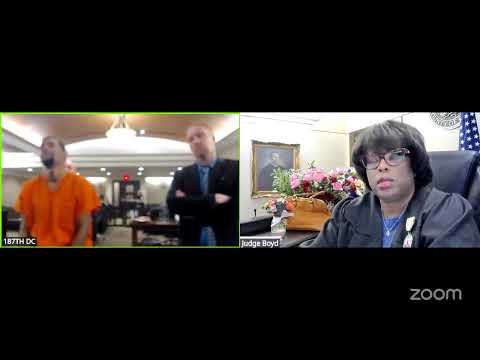
The 187th District Court heard testimony and argument Wednesday in the revocation proceeding for Jameson Robert Franklin (cause 2025 CR00004587).
Franklin, who had been placed on community supervision in 2025 for manufacturing/delivery of a controlled substance, pleaded true to alleged supervision violations presented by the state. The state requested the court grant its motion to revoke supervision and impose a 10-year prison term; defense counsel Jonathan Alvarado acknowledged the potential sentencing exposure while offering mitigation and background materials for the court’s consideration.
The court took testimony from multiple witnesses, including the defendant’s mother, Valerie Gonzalez Franklin, who described her son’s long-standing medical and cognitive impairments and told the court that Franklin had recently asked for help: "my life has... I'm just dying and I can't save myself," she said during direct examination.
Prosecutors argued that Franklin’s pattern of conduct and new charges supported revocation. Defense counsel presented a litigation packet and mitigation materials outlining Franklin’s traumatic brain injury, seizures, and other mental-health diagnoses and asked the court to consider residential therapeutic programming as an alternative to straight incarceration.
The court found violations of conditions true and set a hearing date to receive argument and make a final decision; a request for a ten-year sentence was explicitly raised by the state on the record. The court said it would review the record and mitigation materials before issuing its decision.
What happens next: The court scheduled further argument and planned to announce its ruling following review of the evidence and mitigation materials.