Get Full Government Meeting Transcripts, Videos, & Alerts Forever!
Get email alerts on the Event Management topic
No spam. Unsubscribe anytime.
Carmel-by-the-Sea weighs controlled nighttime 'non-event' for Car Week to curb noise and danger
Summary
Organizers proposed a police-managed, static-parking "non-event" Thursday–Saturday evenings to reduce revving, crowding and unsafe driving; residents pushed for stronger enforcement, targeted speed humps and safeguards for businesses. The plan goes next to the Community Activities Commission.
Organizers of a proposed pilot to bring a calmer, controlled experience to Car Week told residents at a Carmel-by-the-Sea listening session that a police-backed, static-parking "non-event" could cut noise and risky driving while keeping cars visible for visitors and customers.
Ashley, a former library and community activities director for the city, and Nile, a car-week event organizer, sketched the idea: vehicles would enter a controlled footprint downtown during a set window — proposed for 6 p.m. to 10 p.m. — be parked in staged spaces, and be escorted on entry and exit by marshals and police. "This would be controlled entry and exit with police in that intersection," Ashley said, describing plans to park cars downtown, run shuttles and provide staff to manage flow.
Nile described the operational window in more detail: "The idea would be 6 to 10 and we would accompany all cars exiting and entering throughout that period of time," he said, adding that pre-registration, staffed marshals and visible enforcement were central to preventing the engine revving and serpentine driving that residents said made last year unsafe.
Residents and business owners at the meeting voiced mixed reactions. Some favored a static, ticketed display that would keep cars off neighborhood streets and funnel visitors to downtown restaurants and shops; others said the town lacks enough parking to host every vehicle and warned that charging for access on a public right-of-way raises legal and equity questions. "It is really tough on business," said Christy Rmmers, a local business owner, describing years in which Car Week brought crowds but inconsistent sales.
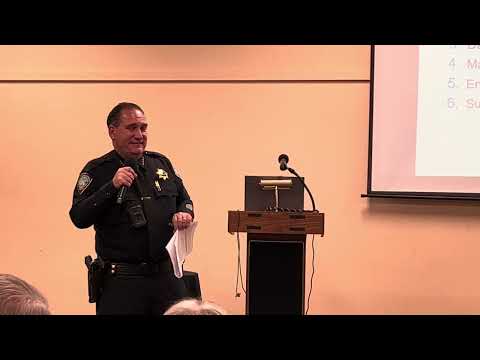
Police representatives and the meeting facilitator emphasized enforcement and training as complementary tools. The facilitator — who identified himself in the session as a police officer and who said, "I did not feel safe last year" — said his department is exploring low-cost sound meters and a peninsula-wide training program to help officers distinguish illegal vehicle modifications from normal operation.
Organizers and some club leaders said they are willing to collaborate on rules and to route proceeds from any fees back to the city or community causes. "We're here to also try to help make things better," said Candy Banian of the Ferrari Club, who urged structured parameters that protect residents while allowing curated displays that often raise funds for local nonprofits.
Next steps identified at the session were procedural: organizers were asked to refine diagrams and operational details and present the proposal to the Community Activities Commission for review before any council action. The listening session produced consistent priorities for follow-up: clearer enforcement (including more officer training and noise monitoring), targeted traffic-calming measures on wide streets, and event designs that keep cars parked and pedestrians out of the roadway.
The organizers and police agreed that the proposal is a pilot concept, not a final plan. The Community Activities Commission will receive the organizers' materials and diagrams; timeline and fee proposals were described as still under development by organizers and city staff.