Get Full Government Meeting Transcripts, Videos, & Alerts Forever!
Get email alerts on the Criminal Justice topic
No spam. Unsubscribe anytime.
Appeals court hears challenge over whether YMCA Early Learning Center qualifies as a 'school' in drug-zone enhancement
Summary
In State v. Forgus, appellate counsel argued the YMCA Early Learning Center is a preschool/daycare and thus outside the statutory definition of a "school" used to enhance drug-trafficking penalties; the prosecutor countered that case law and unobjected-to officer testimony permit a jury to infer a school-zone enhancement. Judges pressed both sides on the record and precedent before taking the case under submission.
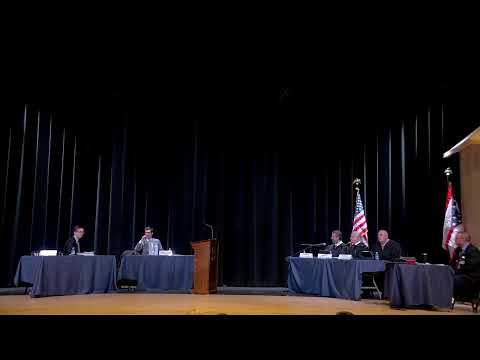
The Ohio Court of Appeals for the Eleventh District heard oral argument in State of Ohio v. David M. Forgus over whether a sentencing enhancement for delivering drugs within 1,000 feet of a school applies when the facility at issue is the YMCA Early Learning Center.
Appellant counsel Adam Parker told the panel that Forgus was convicted after a jury found both the trafficking offense and the accompanying school-zone finding, producing a sentence of six to nine years. Parker said the dispositive question on appeal is statutory: the applicable school definition in Revised Code 2925.01(Q) lists three specific categories (a school operated by a board of education; a community school; and a nonpublic school subject to the director of education’s minimum standards), and the record lacked proof that the YMCA learning center satisfied any of them. "A preschool, nursery school or daycare is not covered by the statutory definition of a school," Parker said, arguing the officer’s testimony that "this constitutes a school" was a legal conclusion with little evidentiary weight and that the facility’s commercial name alone should not automatically fulfill the element required to elevate the offense.
The prosecutor, Dane Hixon of the Ashtabula County Prosecutor’s Office, answered that the duress argument raised by the defense is legally narrow but that on the school specification the state had met its burden. Hixon cited State v. Manley and several courts of appeals decisions that he said allow a jury to infer a facility is a school from the facility’s name and the officers’ testimony when presented to a jury: "Manley does hold that testimony about the name of a school and it being a school is sufficient," he said. Hixon told the court the detective’s testimony was unobjected-to and the jury, applying the instructions it was given, found the enhancement beyond a reasonable doubt.
Judges pressed both attorneys on the limits of those precedents and on the contents of the trial record. The panel asked whether the officer’s use of the word "constitutes" was a conclusory, legal characterization or whether he had personal, lay-observation testimony (for example, that teachers and K–12 grades were instructed there) that could permit a rational juror to infer the facility fit one of the statutory categories. Parker pointed to statutory and administrative provisions (including R.C. 3301.07 and related administrative rules) indicating the director’s minimum-standards authority applies to kindergarten through 12th grade, and he argued that regulatory oversight of preschools/daycares lies elsewhere; he said that factual gap distinguished this case from Manley and other decisions where the record supported the inference.
Hixon responded that several appellate decisions have sustained school-zone enhancements on similar record evidence (names such as "Head Start" or "Kindergarten" and officer testimony), and he urged that the lack of an objection to the testimony and the jury’s verdict should weigh in favor of affirmance or, at worst, render any instructional error harmless.
Both sides also litigated a separate assignment about the duress defense. Hixon emphasized duress is tightly cabined by case law (he cited Strickland and other authorities) to threats that are immediate and continuous for the duration of the criminal act; he argued the record here indicates the alleged coercer arrived partway through the transaction and that Forgus helped create the circumstances by contacting the alleged coercer. Parker replied that preservation and sufficiency issues remain for appellate review and that the duress question was among the assignments presented to the court.
The panel took the case under submission. The judges told the students and public in the audience that a written opinion explaining their decision and reasoning will be made publicly available after they confer.
The court did not take testimony or issue a ruling at the hearing; it closed the record and will issue a written disposition in due course.