Get Full Government Meeting Transcripts, Videos, & Alerts Forever!
Get email alerts on the Criminal Justice topic
No spam. Unsubscribe anytime.
Appeals court weighs whether YMCA Early Learning Center counts as a statutory "school" for drug‑trafficking enhancement
Summary
At oral argument before a three‑judge panel of the 11th District Court of Appeals, defense counsel said a preschool/daycare does not meet Ohio's statutory definition of "school," while the prosecutor urged that the site's name and officer testimony were sufficient for the jury's enhanced trafficking finding.
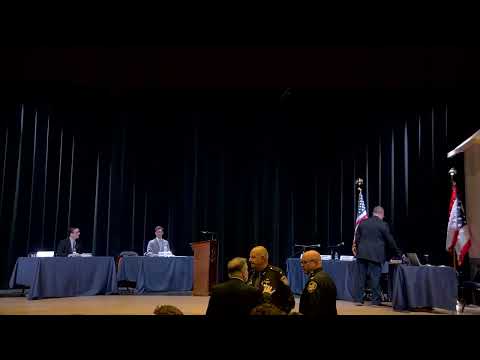
A three‑judge panel of the Eleventh District Court of Appeals heard arguments over whether a drug‑trafficking conviction enhancement — imposed because the offense was alleged to have occurred within 1,000 feet of a school — can rest on the YMCA Early Learning Center's name and trial testimony.
Defense counsel Adam Parker told the panel that the statutory definition in R.C. 2925.01(Q) limits the term "school" to three categories: public schools operated by a board of education, community schools, and non‑public schools subject to the director of education's minimum standards. Parker argued that preschools, nurseries and daycares fall outside those categories and that the record at trial offered only two relevant items of proof: an officer's statement that the place "constitutes a school" (which Parker characterized as a legal conclusion) and testimony that the location's name was "YMCA Early Learning Center (daycare)." He said neither supports a rational juror finding beyond a reasonable doubt that the site fits a statutory category that would trigger the sentencing enhancement.
"A preschool, nursery school or daycare is not covered by the statutory definition of a school," Parker argued, and therefore the prosecution failed to prove the enhancement element by the required standard.
The prosecutor, Dane Hixon of the Ashtabula County Prosecutor's Office, countered that the state presented the same kinds of evidence that appellate courts have previously held sufficient. Hixon cited prior decisions in which the name of a site and officer testimony supported a jury inference that a place qualified as a school. He told the panel that courts should view the record "in the light most favorable to the state" and that a jury could reasonably have found the YMCA site was a school for enhancement purposes.
Judges pressed both sides about what the officer meant by saying the site "constitutes a school," whether that wording was a conclusory legal opinion or reflected lay knowledge about the facility's function, and how controlling Supreme Court precedent (the Manley decision) should be read on the point. The panel also asked whether defense counsel's failure to object to certain jury instructions or verdict‑form language affected the standard of review and whether any error, if present, would be harmless in light of other evidence.
The tribunal was reminded that the enhancement matters: at trial the jury found the additional school‑zone finding and the underlying conviction; the record reflects the trial court imposed a sentence that included a minimum of six and a maximum of nine years for the enhanced offense.
The court did not announce a decision at argument. The panel submitted the case for decision and said a written opinion explaining the court's reasoning will be issued in due course.