Get Full Government Meeting Transcripts, Videos, & Alerts Forever!
Get email alerts on the Housing topic
No spam. Unsubscribe anytime.
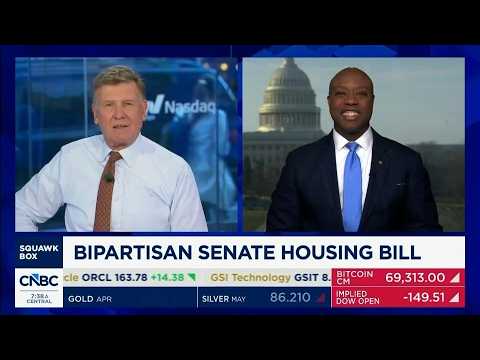
Sen. Tim Scott says bipartisan housing bill cuts red tape, rewards local housing production
Summary
Sen. Tim Scott told interviewers the Senate package combines elements of the House and Senate bills into a bipartisan, "center-right" housing plan that he said uses incentives and penalties to push local jurisdictions to build more housing and expand access to homeownership.
Sen. Tim Scott, chairman of the Senate Committee on Banking, Housing, and Urban Affairs, said in an interview that the Senate housing measure is a bipartisan effort designed to spur local housing production by cutting regulatory red tape and using incentives.
"When President Trump and Elizabeth Warren and the Senate majority Republicans can all come to the same place on a housing bill, what it says is you put partisan politics aside," Scott said. He described the package as "absolutely center right" and said committee members had the opportunity to fold their priorities into the bill.
Scott said the bill combines much of the House language with Senate provisions: "The House passed their bill 399 to 1 and many of the provisions they have, they have 25 basic provisions in their legislation. We've taken 20 of the 25 provisions and embedded them in our '21st Century Road to Housing.'" He added the measure includes incentives to "produce more housing and make it more affordable" and a mix of "carrots and sticks," including shifting funds away from jurisdictions that do not increase housing supply.
He credited senators of both parties, including Sen. John Kennedy, for specific provisions and said the president's support for a narrowed ban on large institutional investors helped secure broader backing. Scott also noted that some House additions — most notably a multiyear ban on central bank digital currency asked for by the House Freedom Caucus — were included to make the House and Senate texts compatible.
The senator framed the bill as an attempt to return authority to local jurisdictions: "We don't understand in Washington how to solve a problem in Greenwood, South Carolina. We have to let Greenwood, South Carolina, solve that problem." He said the package was intended to give local governments stronger incentives and more flexibility to address local housing shortages.
The interview did not record a formal vote in the Senate; Scott described the measure as a bipartisan product intended to move through Congress with presidential support.