Get Full Government Meeting Transcripts, Videos, & Alerts Forever!
Get email alerts on the Public Safety Police topic
No spam. Unsubscribe anytime.
Police chief details staffing, drones and task‑force work as residents press for action on nearby target shooting
Summary
At a special Town of Hope Mills meeting, the police chief outlined staffing, equipment and training plans — including expanded drone use paid for from asset‑forfeiture funds — while residents and commissioners raised persistent safety concerns about target shooting and ATV activity occurring on adjacent county land.
At a special meeting of the Town of Hope Mills Board of Commissioners, the police chief gave an operational overview of the department and defended its partnerships with state and federal task forces as residents urged more action on recurring target shooting near the town’s boundary.
The chief said the department is authorized for 59 sworn officers and currently has 58 filled positions, along with nine traffic control officers and five civilian employees, and described four divisions: patrol, special operations, investigations and school resource officers. "We're authorized for 59 sworn officers...our actual staffing is 58 sworn," the chief said, adding one candidate is in a background investigation and expected to start in March.
Why it matters: Commissioners and residents said the shooting and ATV activity have created safety and quality‑of‑life concerns. Officials emphasized limits on local enforcement when activity occurs on county land and outlined non‑enforcement options being pursued.
The chief reviewed technology and equipment in use and planned purchases: 20 license‑plate readers, a real‑time crime center, forensic tools (GrayKey, Axiom), and a forensic laptop for child‑exploitation work. He proposed buying several small drones so each patrol squad would have an operator and be cross‑trained on the same model. "We're going to purchase the same models," he said, adding the drones and training could be bought using asset‑forfeiture funds.
Board members asked how drone purchases and training would be funded. The chief and a board member confirmed asset‑forfeiture funds could cover both hardware and training as a package, though training might come from a different vendor than the hardware.
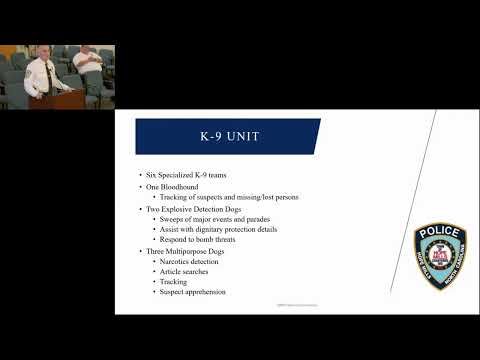
The chief also described specialty teams: six K9 teams (including a bloodhound and two explosive‑detection dogs), an emergency service unit that handles search warrants and high‑risk transports, and community‑policing events — the department reported about 126 community events in 2025 and an on‑staff victim advocate who assists with protective orders and victim services.
Task force cooperation: The chief outlined the department’s role in the Southeastern North Carolina Violent Crime Task Force, which includes state and federal partners such as the SBI, DEA, FBI and U.S. Marshals. Since 2020, he said, task‑force activity has produced 761 charges, seized $311,000 in currency and removed 138 firearms, and task‑force assignments can generate asset‑forfeiture funds that the town may use.
Residents and several commissioners pressed the department about recurring target shooting and ATV use near the town that is largely occurring on adjacent county property. One resident said the noise and the sight of people shooting on ATVs had frightened neighbors and recalled incidents during trick‑or‑treating. The resident said some shooters time their activity to be out of town limits so they can return to county property; the chief agreed that much of the activity is permitted by county rules if minimum setback distances from homes are met.
The meeting included a technical point about distance: the chief noted the closest house to the shooting area was measured at about 1,184 feet, which he said complies with the county ordinance. He also cautioned that policing the sandy, poorly accessible areas is hazardous for officers and that pursuits would be unsafe. "We don't pursue. It's too dangerous," he said, describing tactics such as foot searches, camera placement, landowner outreach, and barrier installation that the town has used.
Next steps and coordination: Commissioners asked the chief to follow up with the county sheriff about coordinated enforcement and possible use of noise ordinances; the chief said he would contact Sheriff Morgan. Board members and residents suggested non‑enforcement remedies including signage, landowner cooperation, coordinated pre‑positioning of units, and exploring noise‑ordinance enforcement as a supplement to police efforts.
Meeting actions: The board approved the meeting agenda and later adjourned; no formal policy or ordinance changes were adopted during the presentation.
The police chief closed the operational briefing with a reminder about competing demands on staffing and the forthcoming budget cycle, which commissioners said will shape any equipment or personnel decisions.