Get Full Government Meeting Transcripts, Videos, & Alerts Forever!
Get email alerts on the Transportation Demand Management topic
No spam. Unsubscribe anytime.
Mountain View committee advances citywide Transportation Demand Management ordinance to council
Summary
The city’s Transportation Committee unanimously approved forwarding a draft Transportation Demand Management ordinance to City Council that would standardize trip-reduction targets, monitoring and enforcement for developments generating 200+ average daily trips, with exemptions for small and affordable projects.
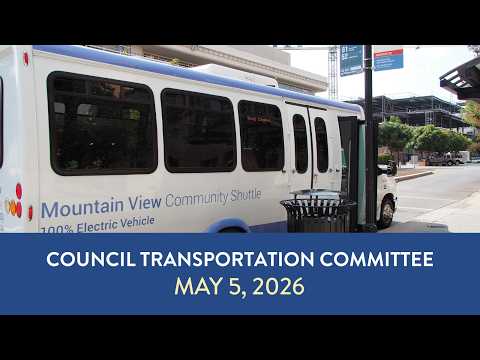
Mountain View’s Transportation Committee voted unanimously to forward a draft Transportation Demand Management (TDM) ordinance to the City Council after a staff presentation and public comment.
Staff said the ordinance would repeal and re-enact Article 10, Chapter 19 of the Mountain View Municipal Code to establish a citywide TDM program that standardizes trip-reduction targets, the planning process, monitoring, and enforcement. “We’re here tonight to discuss the citywide Transportation Demand Management ordinance,” said Allison Ber, assistant public works director, who led the staff presentation.
The draft ordinance would apply to new development, changes of use and expansions that generate 200 or more net new average daily trips (ADT). It sets size-based trip-reduction targets and reporting requirements: small projects (200–499 ADT), medium (500–999 ADT) and large (1,000+ ADT), with corresponding reduction targets and tiered monitoring (staff described annual reporting windows of three years for small projects, 10 for medium and 20 for large projects). Residential and certain “patron-driven” uses would be exempt from some types of performance monitoring while still required to adopt TDM measures and annual reporting.
Staff said the ordinance would include exemptions—100% affordable housing, very small residential projects, small offices and certain patron-driven uses under 100,000 square feet—and would link housing-element incentives to enhanced TDM: projects could qualify for parking reductions if they either exceed their ADT reduction target by at least 5% or adopt additional core and auxiliary strategies from the city’s TDM toolkit.
Committee members pressed staff on neighborhood impacts and enforcement. “If we reduce parking, how do we prevent spillover parking into neighborhoods?” a member asked. Staff replied that parking reductions would be permitted only when developers adopt sufficient extra TDM measures to offset any increase in parking demand and that enforcement would focus on whether required measures from an approved TDM plan were implemented; residential projects are expected to adopt and implement the measures, but the city will not rely solely on measured trip-count reductions to grant incentives.
Public commentators and stakeholders asked staff to clarify scoring and toolkit details before the City Council hearing. David Watson, speaking during public comment, asked that "the limited parking-supply credit shouldn't be contingent on adjacent street parking being metered or permanent" and requested an opt-in pathway for smaller projects under the ADT threshold. Ronnie Hatrick of the Mountain View Transportation Management Association warned that making TMA membership voluntary could reduce shuttle services and urged the committee to create a clear path—such as a PBID—to secure long‑term funding.
Staff told the committee that membership in the city’s TMA would not be mandatory under the ordinance because converting the existing TMA funding approach into a permanent levy could raise legal constraints (e.g., Proposition 218/26 and restrictions on funding private organizations). Instead, staff said it would explore a property‑based assessment district or other mechanisms after adoption.
The committee voted to forward the ordinance recommendation to the City Council for subsequent readings; staff indicated the ordinance will be on the council schedule for first and second readings in May 2026, with implementation steps (program standards, toolkit refinement, a fee study and code updates) to follow.
The committee’s action was procedural: it advanced staff’s recommendation to the council rather than adopting ordinance text at this meeting. The council will consider formal readings and any final amendments.
Next steps: staff will finalize toolkit placeholders, complete a cost-estimation and implementation study to propose an annual TDM fee, and prepare the ordinance and related resolutions for the City Council hearings.