Get Full Government Meeting Transcripts, Videos, & Alerts Forever!
Get email alerts on the Public Space Policy topic
No spam. Unsubscribe anytime.
Council reviews City Square ordinance and six-month social-district pilot allowing 'to-go' beverages downtown
Summary
Council heard presentations on Ordinance 250-26 to govern City Square operations and a six-month pilot social district (Council Memo 25226) that would allow participating Chicago Street businesses to sell one to-go beverage within defined boundaries and hours, with safeguards including eligibility rules, branded cups, and police enforcement measures.
Council members on May 4 reviewed a proposed City Square ordinance that defines the plaza boundary, operating hours, permitted activities, and enforcement authority, and a companion six-month social-district pilot to allow participating downtown businesses to sell one beverage to-go within marked boundaries.
Stephanie Silki, corporate counsel, told the council the City Square ordinance (Council Memo 250-26) defines the square's footprint (the red shaded area shown to council) and delegates closure and operational authority to the city manager when public-safety or infrastructure issues arise. Silki said the ordinance incorporates existing municipal code and state statute provisions and establishes specific prohibitions for the square (examples cited included no weapons, no fires/pyrotechnics without permit, limits on panhandling when conduct becomes harassing, and no sleeping in the square).
On the companion item (Council Memo 25226) Silki described a social-district pilot running June 1–Dec. 31, 2026, permitting eligible Chicago Street corridor businesses (sidewalk-level businesses with a Chicago Street address) to sell one beverage to-go within the district, during hours aligned with City Square (4:00 p.m. start daily; hours vary seasonally). Proposed safeguards include branded cups with date/time and a designated map and banners marking the district; eligible businesses must have a full kitchen and have alcohol sales comprising 40% or less of total sales.
Council members asked staff about inclusion of nearby small businesses and limits on panhandling. Staff clarified the ordinance targets harassing conduct rather than banning panhandling outright because of First Amendment limits and noted that allowing people to cross state routes with open containers could require state permission. The council also confirmed scooter/ebike restrictions apply in the square.
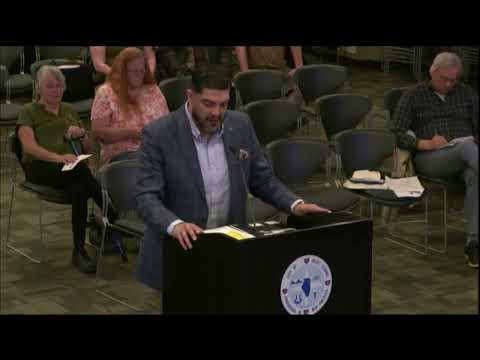
Emanuel Lopez, executive director of the Joliet City Center Partnership, told council the pilot would "bring more energy and more foot traffic to downtown" and give the city a controlled way to test the concept and make adjustments.
Next steps: staff will finalize ordinance language and details; the liquor-commissioner oversight and the pilot's six-month sunset mean renewal would require further council approval.