Get Full Government Meeting Transcripts, Videos, & Alerts Forever!
Get email alerts on the North Star Promise topic
No spam. Unsubscribe anytime.
Senate committee hears North Star Promise briefing as advocates urge widening eligibility
Summary
The Senate Higher Education Committee received Office of Higher Education data showing the North Star Promise served tens of thousands in FY25 and heard testimony supporting bills that would remove or raise income caps to expand aid to more two-year and tribal college students; lawmakers adopted an A1 fiscal amendment and left the bills pending.
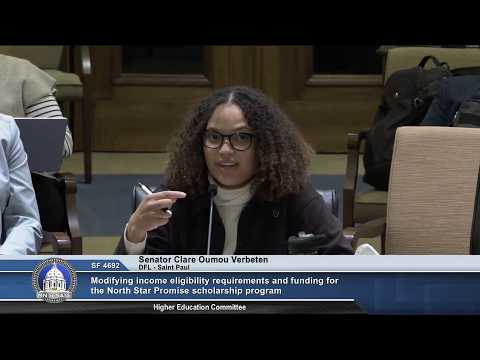
The Minnesota Senate Higher Education Committee on April 6 heard a detailed briefing from the Office of Higher Education on the North Star Promise program and testimony from students, faculty and university officials urging the Legislature to expand eligibility.
Office of Higher Education program administrators Tara Winchester and Kerry Schneider told the committee that North Star Promise operates as a last-dollar base award (NSP Base) and a Pell-based supplement (NSP Plus). Winchester said the office reported roughly 61,024 students received NSP awards in fiscal year 2025 and described the FY25 appropriation as about $112.8 million; she said the ongoing appropriation beginning in FY26 is $49.5 million per year. The presenters also said NSP Plus awards, which matched a share of federal Pell grants, were set at 15% in FY25 but the match has been set to 0% for FY26 and is projected at 0% for FY27 based on available funding.
"North Star Promise is a last-dollar award designed to cover remaining tuition and mandatory fees after other scholarships, grants and waivers have been applied," Winchester told the committee. She said the program is available to eligible students at Minnesotas public institutions and tribal colleges and emphasized program delivery in fall, spring and summer terms.
Students and higher-education advocates described the programs effect on access and urged expansion. A student testifier who identified themselves as a community college student and student-leader said the Promise "made college a viable choice for my family," citing caregiving duties and learning-disability accommodations that were manageable with the program's support. Mark Graham, a faculty member at Dakota County Technical College and government relations representative for Minnesota State college faculty, said expanding the Promise would help address workforce shortages by drawing more Minnesotans into two-year programs that lead quickly to in-demand jobs.
Lawmakers framed two bills under consideration as aspirational changes to the program. One proposal discussed would remove the $80,000 adjusted gross income cap for students attending two-year public and tribal colleges; another would raise the family adjusted gross income limit to $100,000. Committee members repeatedly noted those changes carry substantial fiscal implications and that final funding depends on broader appropriation negotiations.
Committee members pressed for student-outcome data; the Office of Higher Education said consolidated outcome measures and completion/persistence metrics should be available in the consolidated financial aid report due February 2027. University representatives also offered supplemental estimates: Nate Peterson of the University of Minnesota Student Finance said raising the eligibility cap to $100,000 would make roughly 1,323 additional students at the University of Minnesota system eligible, based on 202526 figures.
On procedure, Senator Cook moved an A1 amendment to replace a placeholder with the fiscal-note projected costs; the committee adopted that amendment by voice vote. The hearing transcript records the amendment's adoption but does not record committee passage of the underlying bills; members left the measures pending for further consideration.
Why it matters: witnesses and legislators said North Star Promise has demonstrably increased access and that expanding eligibility for two-year programs could expand workforce pipelines in health care, manufacturing and the trades. But several senators cautioned that expansion must be funded and coordinated with state grant programs and wraparound services such as childcare, transportation and food support to help students persist and complete degrees.
What comes next: Committee members asked the agencies for follow-up data, and sponsors and staff signaled further fiscal analysis and interchamber negotiations will determine whether the proposed eligibility expansions move forward.