Get Full Government Meeting Transcripts, Videos, & Alerts Forever!
Get email alerts on the Facilities Ac topic
No spam. Unsubscribe anytime.
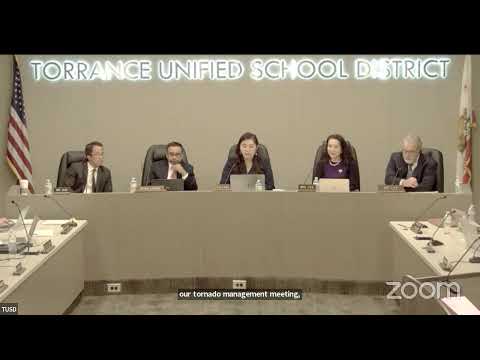
Teacher and parent urges Torrance Unified to install air conditioning after heat wave
Summary
During public comment, Charlotte Iten—a parent, teacher and veteran—urged the district to explain why many classrooms lack air conditioning after a heat wave that she said produced classroom temperatures up to 92°F and caused student fainting; trustees discussed short‑term mitigation and long‑term bond planning.
Charlotte Iten, who identified herself as a Torrance parent, veteran and classroom teacher, told trustees the recent heat wave left some classrooms as hot as 92°F and said students and staff experienced heat‑related illness. She asked why the district has not installed air conditioning in all classrooms and whether the district will pursue a bond to fund a system‑wide installation.
"What is Torrance Unified actively doing to comply with these recommendations?" she asked, citing California guidance for indoor workplaces during extreme heat. Iten said she nearly fainted during the heat wave and reported students fainting at schools.
Board members acknowledged the seriousness of the heat event and the public concern. Trustees said district staff had used short‑term measures during the heat wave—designating cool rooms, supplying water and providing fans—and noted that estimating and installing district‑wide air conditioning would be a multi‑year, multimillion‑dollar effort that would likely require voter approval of a bond. One board member recalled a prior district estimate (cited in the meeting) of roughly $300 million for full installation and said any bond would require community outreach, citizen advisory committees, site assessments and cost‑ing before placement on a ballot.
Several trustees asked staff to develop a formal extreme‑heat mitigation plan that would specify thresholds for actions (for example, when to declare minimized days, open cooling centers or alter schedules), communications protocols for parents, and interim measures to protect students and staff while longer‑term planning proceeds.
Next steps: Trustees asked staff to bring back short‑ and long‑term heat‑mitigation options and a timeline for community engagement and possible bond planning.