Get Full Government Meeting Transcripts, Videos, & Alerts Forever!
Get email alerts on the Bond Planning topic
No spam. Unsubscribe anytime.
Piper Sandler adviser outlines bond financing options as Sultan board prices new high school and expansions
Summary
Piper Sandler adviser Trevor Carlson gave the board an overview of bond timing, passage rates, debt capacity and a sample $100 million two‑sale bond plan; administrators described candidate projects including a new high school on Sultan Basin Road, a Goldbar expansion and community turf.
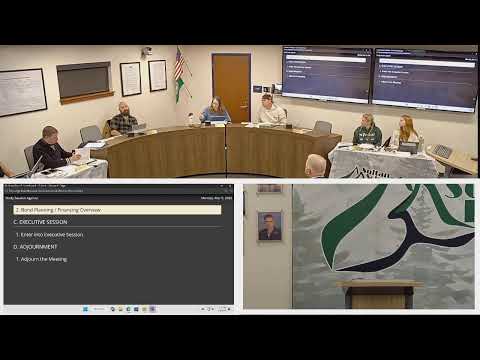
Trevor Carlson, a bond adviser with Piper Sandler, told the Sultan School District board on March 9 that the district is in the early stages of bond planning and walked trustees through timing options, historic passage rates and a sample financing designed to stabilize tax rates.
"There have been no decisions made," Carlson said, emphasizing the presentation was educational. He outlined the four ballot opportunities (February, April, August and November) and said long‑term passage rates average roughly 40%, noting that August election dates are typically the least successful. Carlson also explained validation: for bonds the district must meet both the 60% approval threshold and a turnout threshold (about 40% of the last general election) to validate the measure.
On legal capacity, Carlson said the state constitution limits school districts’ voted debt to about 5% of assessed value and used a district tax base figure of roughly $3.44 billion to illustrate a theoretical maximum borrowing limit (~$170 million), reduced to about $167 million after accounting for outstanding non‑voted debt.
Carlson presented a sample bond‑sizing model that used conservative assumptions (assumed assessed‑value growth of about 3% and a contingency margin on interest rates) and split a hypothetical $100 million into two sales (an example schedule: $50 million in March 2027 and $50 million in September 2028). He said structuring multiple sales can help smooth taxpayer impacts and coordinate with construction cash flows.
Using a notional $550,000 home, Carlson showed how tax rates in the model translate into annual property tax amounts and how the package would raise taxes in initial years with a modeled step‑down when an existing capital levy expires. "You have to start planning backwards," he said, citing deadlines such as delivering a resolution to the county auditor by Dec. 11 for a Feb. 9, 2027 ballot.
Following the financing overview, the board and administration summarized projects CFAC and architects are pricing: a new high school on the Sultan Basin Road property (about 32 classrooms including CTE and two gyms), an 18‑classroom expansion and gym/cafeteria at Goldbar to consolidate preschool–2, moving grades 3–5 into the middle‑school footprint, site modifications to remove portables and a community turf area for local use. Administrators also noted a potential CTE broadcasting upgrade tied to bond funding to support a new broadcasting class.
Board members discussed timing and turnout tradeoffs for November versus February ballots, the need for a citizens committee and outreach, and planned architect site visits to refine scope and cost estimates. Staff said they hope to have pricing from architects and a resolution available for the board to consider before April so the district can decide whether to target a November ballot.
No formal bond resolution or vote was taken at the meeting.