Get Full Government Meeting Transcripts, Videos, & Alerts Forever!
Get email alerts on the Non Transportation Zones topic
No spam. Unsubscribe anytime.
Stafford board weighs stricter safety tests for ‘non-transportation’ zones, seeks data before changes
Summary
Board members reviewed plans to re-evaluate non-transportation zones (NTZs) — areas where the division would stop providing bus service — and asked staff for crash data, principal review and public engagement before any expansions; staff said NTZs may be up to one mile under policy but that they prefer NTZs to be walkable.
Stafford County Public Schools staff told the school board on March 10 that the division’s policy allows non-transportation zones (NTZs) up to one mile from a school, but that the safety committee has been favoring zones that are genuinely walkable rather than simply within a mile.
"Anybody that falls within what we identify as a non-transportation zone are responsible for their own students travel to and from school that day," a staff presenter said, describing the current rule that families inside an NTZ must provide transportation themselves.
The board heard that NTZ designations are currently produced by a multi-agency safety team that includes school staff, county staff, the sheriff’s office and VDOT; the team evaluates sidewalks and crosswalks, line of sight, shoulder conditions and the potential to place crossing guards. Staff emphasized that the regulatory allowance of a one-mile NTZ does not mean every location within a mile is automatically appropriate.
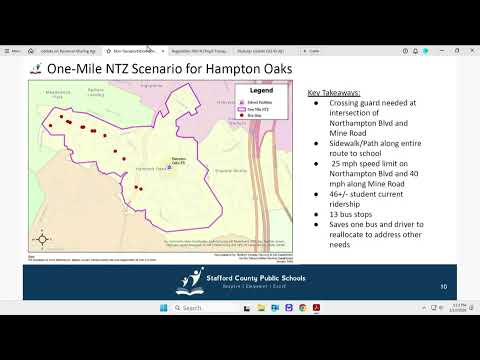
Staff gave two concrete scenarios: Hampton Oaks, where staff argued existing traffic controls and a crossing guard could make an expansion across Mine Road viable and could save one bus route; and Ferry Farm, a residential area with little sidewalk infrastructure where staff said students already walk to bus stops but crosswalks are lacking.
Board members repeatedly pressed for more evidence before approving any NTZ expansion. They asked staff to: - pull and present crash and pedestrian hazard data for candidate areas; - involve principals and the transportation advisory committee in reviews; - hold targeted community outreach rather than just general hearings; and - return with a clear implementation timeline tied to redistricting and enrollment changes.
Staff recommended a phased, cautious approach: complete the safety-team reviews this year, collect fall enrollment data and return with proposals the board could consider for implementation in the 2027–28 school year. "Let's kind of put a hold on it until after we finish redistricting and let's come back and look at it," staff said earlier in the discussion.
The board did not vote on any NTZ designation at the meeting; members asked staff to return with the requested data and proposed public-notice steps.
Looking ahead, staff said they would use the NTZ regulation’s criteria but would seek board direction about whether to interpret the one-mile allowance strictly as a radius or as a street-network distance and whether to require defined walkable infrastructure for any NTZ.
The board's next step is for staff to reconvene the safety committee, gather crash and pedestrian data and bring a more detailed, site-specific proposal and outreach plan back for discussion later this year.