Get Full Government Meeting Transcripts, Videos, & Alerts Forever!
Get email alerts on the Realignment Plan topic
No spam. Unsubscribe anytime.
Santa Monica Planning Commission narrows realignment plan ROIs, advances downtown and city‑owned‑site options
Summary
After a study session on implementing the council‑approved realignment plan, the Planning Commission approved amended resolutions of intention that advance downtown incentives and flexibility for city‑owned gateway sites while removing a proposed boulevard low‑scale incentive amid affordability and displacement concerns.
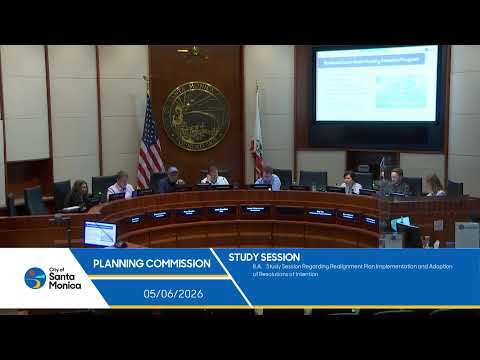
The Santa Monica Planning Commission on May 6 discussed staff‑draft concepts to implement the City Council's realignment plan and voted to advance amended resolutions of intention that prioritize downtown housing incentives and flexibility for city‑owned gateway parcels while removing a proposed boulevard low‑scale incentive.
Staff framed the meeting as a study session on initial concepts — a boulevard low‑scale housing incentive, a downtown housing incentive tied to a height offset, and special flexibility for selected downtown city‑owned sites — and sought commission direction before drafting formal code amendments. Planning staff said the ideas are preliminary and intended to spur feedback; staff showed a tentative schedule to return with recommendations in June and take items to council in July.
"These are initial draft concepts that we want to walk through with you," the planning director said, describing options intended to promote family‑sized ownership units and to focus larger scale growth in downtown. The boulevard concept would have offered lower maximum heights (staff cited 55 feet as an example) in exchange for unit‑mix requirements (two‑ and three‑bedroom emphasis) and fee concessions; the downtown concept would allow projects to choose on‑site, off‑site or fee‑in‑lieu compliance with the city's Affordable Housing Production Program (AHPP) while providing a local density bonus tied to increased downtown height; the city‑owned‑site concept would exempt certain downtown public parcels from baseline zoning to allow greater flexibility under council‑directed agreements.
Commissioners raised two consistent concerns: whether broad AHPP relief for for‑sale projects would erode local affordability, and whether the boulevard incentive could accelerate displacement in historically vulnerable commercial and residential corridors. "How does encouraging a lot more market‑rate for‑sale housing without any AHPP requirement serve our community goals of protecting our most vulnerable people?" Commissioner Fresco asked, urging caution on waiving affordable housing requirements.
Other commissioners asked staff for additional analysis before moving forward. They requested a parcel‑universe study to identify where the boulevard incentive would realistically be exercised, pro‑forma feasibility modeling for small‑ and mid‑scale projects, clarity on how state laws (including SB79 and the state density bonus) would interact with a local program, and legal analysis of discounted impact fees in light of recent court decisions.
Public testimony from representatives of the Neighborhood Task Force supported focusing density in downtown and the gateway and reducing boulevard profiles to improve transitions to adjacent neighborhoods, and said the group would deliver a white paper with additional options.
After discussion, commissioners negotiated an amendment to the draft resolutions to remove language initiating zoning changes for the boulevard low‑scale incentive. The commission then approved the two resolutions of intention — identified in the meeting as Resolution Nos. 26‑006 and 26‑007 — as amended. A roll call recorded five yes votes from Commissioners Fresco, Landress, Wasserman, Vice Chair Choco and Chair Hamilton; two commissioners (Lambert and Reese) were absent. The approved ROIs will allow staff to develop drafts and bring formal resolutions of recommendation back to the commission for more detailed review.
Commissioners signaled support for further study of targeted tools the city could use to reduce displacement risk (minimum unit floor areas, small ground‑floor commercial floor plates, anti‑displacement conditions tied to approvals), and several members suggested limited pilot programs rather than citywide code changes. Staff said they will return with more detailed options, feasibility work and recommended safeguards.
The commission concluded the study session by affirming interest in advancing downtown and city‑owned site concepts while pausing the boulevard incentive pending additional analysis and refinements. The commission then moved on to routine business and adjourned.