Get Full Government Meeting Transcripts, Videos, & Alerts Forever!
Get email alerts on the Housing topic
No spam. Unsubscribe anytime.
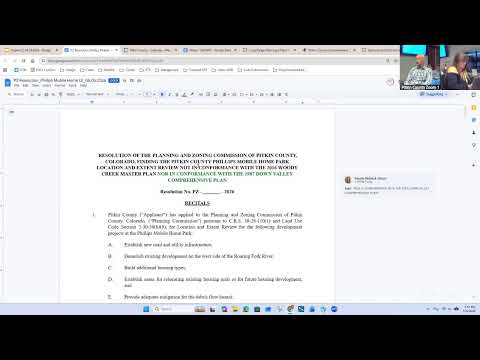
Planning commission finds Phillips Mobile Home Park not in conformance with Woody Creek master plan
Summary
Pitkin County’s Planning & Zoning Commission on May 5 approved a resolution finding the county-owned Phillips Mobile Home Park project not in conformance with the 2016 Woody Creek master plan and with the 1987 Down Valley comprehensive plan, after extended public comment and debate about infrastructure, wildlife and whether the county’s purchase was intended to preserve or expand housing.
The Pitkin County Planning & Zoning Commission voted May 5 to find that the county’s proposed Phillips Mobile Home Park project is not in conformance with the 2016 Woody Creek master plan and is not in conformance with the 1987 Down Valley Comprehensive Plan.
Planning staff opened the continued location-and-extent review with a summary of referral materials, including a letter from the Woody Creek Caucus and comments from Colorado Parks and Wildlife (CPW). Staff advised the commission that the Woody Creek plan and the Down Valley plan are both applicable for review; the packet includes excerpts intended to clarify findings of nonconformance.
County staff (Kevin) outlined why the Board of County Commissioners purchased the Phillips Mobile Home Park in 2018: to preserve naturally occurring affordable housing and to address long-standing infrastructure needs. Kevin said subsequent investigation showed the park’s water and wastewater infrastructure required full replacement and that modest additional capacity (roughly a 20% increase in infrastructure) could allow the system to serve about 50% more units and spread long-term operations and maintenance costs across more households.
During public comment, scores of residents and neighbors urged the commission to deny or limit expansion. Speakers raised common concerns: the project’s Highway 82 location requires car travel for most trips, the risk that current residents could be displaced during redevelopment, uncertainty about concrete relocation guarantees, wildlife and scenic impacts, and skepticism that added infrastructure equates to preservation of existing units rather than creation of new density.
Commissioners debated plan hierarchy, whether the Down Valley plan is superseded by more recent area plans in some places, and what findings should be included in the resolution. Planning director Ry explained the process: a PNZ finding of nonconformance prevents permits from issuing unless the Board of County Commissioners takes a subsequent action to allow the project.
After editing the resolution language to remove claims the commission could not substantiate on the record and to focus on measurable nonconformance items (clustering, infrastructure as a growth generator, limited transit access, and proximity to mapped wildlife winter range), Commissioner Krabacher moved the resolution that the project is not in conformance with the 2016 Woody Creek master plan nor the 1987 Down Valley plan; Commissioner Joe Mason seconded the motion. The commission voted unanimously in favor.
The PNZ decision is a formal finding in the quasi-judicial location-and-extent review process; it now goes to the Board of County Commissioners, which may accept, modify or overrule PNZ’s finding through its procedures and a majority vote. The BOCC’s review could consider broader financial or policy tradeoffs beyond the PNZ record.
Next steps noted on the record: the resolution and the PNZ record will be forwarded to the BOCC for its consideration; permits cannot be issued while PNZ’s finding of nonconformance stands unless the BOCC takes action to change the outcome.