Get Full Government Meeting Transcripts, Videos, & Alerts Forever!
Get email alerts on the Strategic Planning topic
No spam. Unsubscribe anytime.
LCCMR subcommittee adopts vision and mission, reviews expert survey and debates NRTF goal wording
Summary
The Legislative Commission on Minnesota Resources subcommittee adopted a Top Choice vision and mission for the ENRTF and reviewed results from a 360‑response subject-matter-expert survey; members pressed staff for more underlying data, debated wording on renewable energy goals, and discussed outreach to younger Minnesotans.
The Legislative Commission on Minnesota Resources subcommittee voted to adopt a Top Choice vision and mission that staff will use to shape strategies for the Environmental and Natural Resources Trust Fund and a draft 2026 request for proposals.
Representative Hansen moved to adopt the survey’s Top Choice for the vision statement — a text emphasizing Minnesota’s lands, waters, fish and wildlife as “plentiful, healthy, resilient and appreciated” — and the motion prevailed by the affirmative votes of the members present. The subcommittee then approved a Top Choice mission describing the ENRTF’s role “to fund environmental and natural resource projects that best protect, conserve, preserve and enhance Minnesota’s air, water, land, fish, wildlife and other natural resources.”
Why it matters: The adopted vision and mission will guide priorities for the six‑year strategic plan and how staff translates goals and strategies into the 2026 ENRTF RFP language that applicants will use.
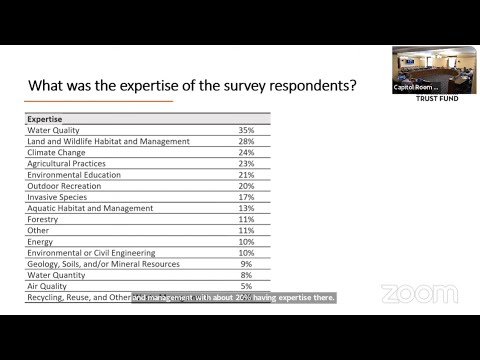
Staff (Mike Compana) reviewed the planning schedule and stakeholder engagement: three subcommittee presentation days are scheduled for June 20, June 26 and June 28, with a July 31 meeting concurrent with the full commission, an Aug. 20 standalone meeting and a tentative Sept. 24 date if needed. Compana told members staff will translate agreed goals and strategies into a draft 2026 RFP and aims to present a formal strategic plan for consideration by the full commission in November. “We received 360 responses to the subject matter expert survey,” Compana said as he summarized who answered and how experts ranked the working goals.
Compana summarized rankings from subject-matter experts and the public: experts ranked resiliency to climate change, land-use change and extreme weather as the top ENRTF goal, followed by water resources (quantity and quality) and healthy, diverse wildlife and plant populations. Public survey responses (a separate, larger dataset) also emphasized wildlife habitat, lakes and rivers, climate change and water quality.
Members pressed staff for more underlying data and for clarifications about the expert survey. Senator Green urged the commission to make data accessible when it asks the public and applicants to prioritize topics, noting the difference between technical measures (parts per million/billion/trillion) and public perceptions. Representative Hinman and Commissioner Reese expressed concerns about relying on “self‑declared” expertise in the survey and asked staff to provide the invitation list and affiliations if helpful to verify respondent backgrounds. Several members asked for stronger outcome and evaluation language to be incorporated in goals and potential RFP language, so funded projects demonstrate measurable results rather than produce repeat studies.
A specific wording debate focused on goal six, which in the working language reads that Minnesota “achieves reliance on non‑polluting renewable energy.” Commissioner Reese asked staff to consider removing “non‑polluting” because the modifier could narrow eligibility for certain renewable technologies (for example, biomass) that some members want the fund to consider. Other members suggested reframing that goal toward “innovation on renewable energy” or similar wording to emphasize the trust fund’s role in advancing new solutions.
Members also discussed engagement gaps for younger Minnesotans and geographic outreach: staff noted the public-response packet is extensive (65 pages of open-ended answers) and additional analysis will be shared in future meetings. Staff will return with revised goal and strategy language, and the subcommittee will continue the line-by-line work during upcoming presentation meetings.
Next steps: staff will refine goal wording, strategies and RFP language based on the discussion and survey results and return to the subcommittee; the full commission is slated to consider a formal strategic plan in November. The chair adjourned the subcommittee at the end of the meeting.