Get Full Government Meeting Transcripts, Videos, & Alerts Forever!
Get email alerts on the Subdivision Control Ordinance topic
No spam. Unsubscribe anytime.
Boone County APC sends clarifying minor-subdivision amendments to county commissioners
Summary
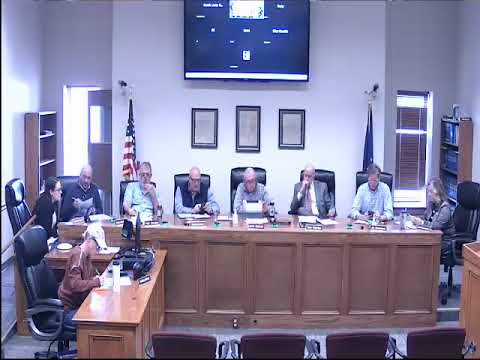
The Boone County Area Plan Commission voted to forward clarifying revisions to the subdivision control ordinance to the county commissioners, removing ambiguous "one-time only" language about parent tracts and aligning the ordinance with long-standing administrative practice; commissioners also agreed to form a workshop for broader changes.
The Boone County Area Plan Commission voted to recommend that the county commissioners adopt clarifying amendments to the subdivision control ordinance that align the written code with long-standing administrative practice and the current interpretation of minor-plat rules. The commission moved the staff-drafted edits forward with a favorable recommendation to the commissioners.
Nicole, a planning staff member, told the commission the amendments would clarify that a parent tract "is a parcel that existed on November 1st of 1998 when the first subdivision ordinance was established," and would remove language that had been read to limit subsequent minor subdivisions to a single split. "It does not restrict the number of lots. It will remain at the four total lots," she said in explaining the changes to existing wording.
The discussion centered on two approaches. Commissioner Jay proposed a larger rewrite to replace the perpetuity rule with a five-year lookback — requiring prior divisions of a parent tract to have occurred more than five years before a new application — but he withdrew that broader change from immediate consideration so the staff clarifications could move forward. Jay said his version "would propose to say ... prior divisions in which the parent track was involved ... must have occurred greater than five years prior to the submittal of the application." He recommended further study and a workshop before any larger policy change.
Multiple commissioners and applicants supported the staff clarifications as a necessary correction to current practice. Brian King, a landowner who has a pending application, told the commission he had submitted an application to split a 7.4-acre lot and asked that the ordinance change clear the way for his pending minor-plat application. A speaker representing another applicant commended staff for the clarification but raised a technical question about how prior divisions and statutory exemptions (for joining transfers, for example) would be counted; counsel and staff explained that joining transfers are not intended to create separate buildable lots.
The commission voted to send the clarifying amendments to the county commissioners with a favorable recommendation; staff identified the county commissioners' meeting on May 18 at 9:00 a.m. in the same room as the next procedural step for formal adoption. Commissioners also agreed to form a workshop or committee to study broader revisions, including Jay's proposal, at a later date.
Why it matters: The changes clarify the definition and treatment of "parent tracts" in the minor-subdivision process. That language affects whether landowners can split parcels administratively or must undergo more comprehensive subdivision review, which in turn affects potential housing density, infrastructure planning (wells, septic, roadway impacts), and how past divisions count toward future entitlement.
Next steps: The APC's favorable recommendation will be presented to the Boone County commissioners for formal adoption; staff will also organize a workshop to review broader code changes and potential policy options for limiting or permitting additional minor subdivisions.