Get Full Government Meeting Transcripts, Videos, & Alerts Forever!
Get email alerts on the Budget topic
No spam. Unsubscribe anytime.
MCALLEN ISD trustees review budget options as payroll, enrollment and one-time revenues shape 2026–27 draft
Summary
Trustees heard that enrollment decline and payroll-driven costs leave the district facing a multimillion-dollar shortfall; staff proposed a package of partial benchmark increases, targeted staffing moves to federal funds, and a compensation scenario that would create a deficit covered from fund balance.
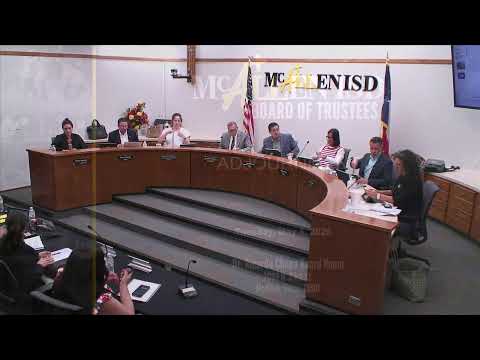
Trustees of MCALLEN ISD met in a budget workshop to review the district’s financial outlook, compensation proposals and department funding requests as they prepare the 2026–27 draft budget. Deputy Superintendent Lorena Garcia told the board that payroll accounted for about $226 million of last year’s $311 million in revenue (roughly 73%), leaving the district heavily exposed to personnel costs as enrollment declines.
Garcia said enrollment has fallen faster than staffing—enrollment declined about 4.8% while staffing dropped about 3.1%—and that new programming (including collegiate partnerships, a STEM academy and expanded dual‑enrollment and bilingual courses) and increasing special‑education needs have driven some staffing additions. The district reported using a cohort projection that produced an ADA (average daily attendance) estimate of about 17,522; staff said state aid and ADA figures will be recalculated after an updated property‑value notice.
Finance staff said a late notice from appraisal authorities changed the picture used to prepare the presentation: a prior estimate showed a 1.7% rise in property values, while an updated notice projected about a 4% decrease. Staff attributed the change to House Bill 9, which exempts $125,000 in business personal property, and said the state’s funding formulas should backfill entitlement dollars but the change can affect the district tax rate.
To narrow the gap, staff recommended partial funding of department benchmark requests rather than the full amounts. Facilities, transportation, technology, advanced academics, athletics and fine arts requested increases; staff initially modeled 100% of those requests but reduced funding to 50% in the draft to limit the deficit. Staff said bond proceeds from recently approved bond work may remove some facilities needs from the general fund.
On technology, the administration described a lease for devices and proposed budgeting $1 million this year toward a $1.5 million lease payment that covers 2,900 Lenovo staff laptops and about 4,200 student Chromebooks; the remaining payment could be added by budget amendment after November audit savings are clear. Athletics and fine‑arts increases were shown in partial breakdowns: fine‑arts asked for roughly $180,000 and staff proposed about $90,000; athletics’ net proposed increase was about $257,000 (staff said athletics had originally requested slightly more).
Staff presented cost‑containment moves: a scenario flagged about 52 positions as potential attrition savings (estimated at nearly $2 million) and proposed a $50‑per‑employee monthly increase in employer health contributions (about $2 million). The team said it is reviewing vacancies and exploring reclassifying positions into federal funds; trustees were told there is a roughly $1.4 million Title I surplus that could be used to move some staff from local fund 199 into federal funding when allowed.
On compensation, staff modeled a package that would give teachers a 2% raise, administrators a 1% raise, and hourly employees a $1 hourly increase while moving the hourly minimum to $15. That scenario produced a draft deficit of roughly $6.3 million before identified savings; staff said identified adjustments have reduced the modeled shortfall by about $1 million in follow‑up runs but that raises cannot be funded without drawing on fund balance.
Board members asked for additional detail before final decisions: trustees requested a line‑item breakdown for benchmark increases, a global list of proposed stipend changes, clear criteria for approving new positions and stipend thresholds tied to participation, and fringe‑cost projections for any new hires (including estimated annual health‑insurance costs). Several trustees urged creation of a rubric for evaluating new positions and stipends so requests are evaluated consistently.
Staff said next steps include continuing vacancy reviews, exploring federal reclassifications, and bringing more detailed breakdowns (stipends, technology lease timing, fine‑arts/athletics line items) to the next workshop. The board set Workshop #6 for June 16 and the final budget presentation for June 23. The meeting adjourned following a motion and vote; the transcript records one opposed vote on the adjournment motion but does not identify members by name in the roll call.
The workshop produced no binding action on the budget itself; trustees asked for follow‑up data and further scenarios before any formal adoption vote.