Get Full Government Meeting Transcripts, Videos, & Alerts Forever!
Get email alerts on the Victim Services topic
No spam. Unsubscribe anytime.
Committee hears pleas to fund victim services with $12 million one‑time appropriation
Summary
Lawmakers heard extensive testimony from tribal, rural and statewide victim‑service providers urging a $12 million one‑time FY2027 appropriation (HF1082, as amended) to offset declining VOCA funding and avert service cuts that would close shelters, reduce advocacy and crisis‑line capacity.
Chair Mueller presented House File 1082, amended to add a one‑time $12 million FY2027 appropriation to the Minnesota Victims of Crime special revenue account, and framed the measure as an emergency response to declining federal VOCA receipts. "12 million dollars is the bare minimum needed to keep these lifesaving programs afloat in Minnesota," the bill author told the committee.
More than a dozen providers and coalition representatives testified that federal Victims of Crime Act funding has trended downward and that Minnesota programs have relied on repeated one‑time state appropriations to maintain services. Nicole Matthews, chief executive officer of the Minnesota Indian Women's Sexual Assault Coalition, said coalitions representing tribal and culturally specific providers fear further federal instability and urged the Legislature to back the amended funding.
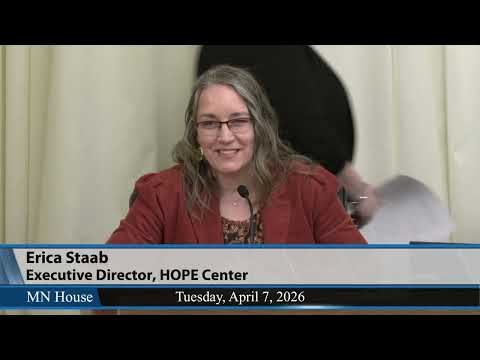
Rural advocates described the practical consequences of flat or reduced funding. Erika Stab, executive director of the Hope Center in Faribault, said her seven‑person staff served more than 1,000 clients last year and that cuts already forced program eliminations, delayed hires and curtailed travel and training. She warned that a projected 20% cut in federal competitive grants would not translate to a 20% service reduction but could mean full loss of services in some counties.
Testimony from children’s advocacy centers and crisis‑line operators emphasized that the requested funds would preserve core response capacity — court accompaniment, forensic exams, housing assistance and 24/7 crisis lines. Kim Bayby, executive director of the Office of Justice Programs, told members that roughly 175 organizations currently receive state funding through competitive processes and described how the OJP uses geographic distribution, crime data and community review to allocate grants.
Members asked for additional details about distribution methods and raised concerns that smaller counties with limited grant‑writing capacity might be disadvantaged. OJP staff said the current RFP includes community review and that the agency attempts to correct for disparities in application capacity. Committee members also noted that marriage‑license fee deposits to the special revenue account have begun but are far short of the $12 million target.
The committee laid over House File 1082, as amended, for further consideration. The record includes dozens of written support letters and on‑table testimony documenting local closures, staff reductions and increased demand across the state.