Get Full Government Meeting Transcripts, Videos, & Alerts Forever!
Get email alerts on the Wealth Tax topic
No spam. Unsubscribe anytime.
Chair Gomez proposes 1% annual tax on wealth above $10 million; members debate feasibility and fairness
Summary
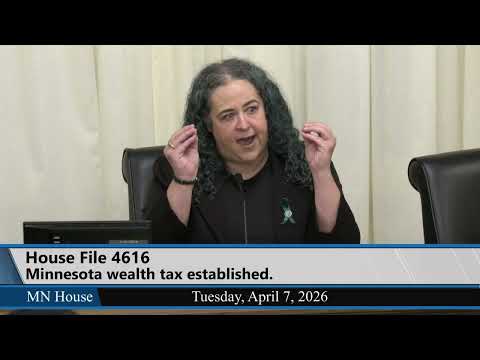
House File 4616 would impose a 1% annual tax on net wealth above $10 million. Supporters framed the measure as needed revenue to address inequality and fund public services; opponents warned of administrative burdens, constitutional risk, and damage to business competitiveness. The committee laid the bill over for possible inclusion in the 2026 tax bill.
Chair Gomez presented House File 4616 to the committee as an annual 1% tax on net wealth above a $10 million threshold, framing the proposal as a response to increasing wealth concentration and the rising costs facing working- and middle-class Minnesotans.
During presentation, Chair Gomez described widening economic inequality and said the state must modernize its tax code: "We have people living on our streets. We have kids who don't have a place to lay their head at night," she said, arguing that taxation funds essential public services. Gomez acknowledged the bill raises practical questions about valuation, thresholds and administration that would need to be resolved.
Public testimony divided along predictable lines. Labor, educators, public-health staff and some small-business owners supported the bill as a way to raise revenue for child care, schools and public health; a child-care provider said the proposal would help build a sustainable universal child-care system. Opponents included the Minnesota Chamber of Commerce, the Minnesota Business Partnership and the National Federation of Independent Business, which warned that annual wealth taxation would be administratively complex, could force illiquid taxpayers to sell assets to pay tax, and would harm Minnesota's competitiveness.
Fiscal and revenue experts raised technical concerns. The Minnesota Center for Fiscal Excellence noted the bill ties valuation to the federal estate-tax standard (Internal Revenue Code section 2031), which is designed for one-time valuations at death and typically triggers appraisals and litigation; the witness said annual mark-to-market valuations would create a different and costly administrative burden for the Department of Revenue.
Members debated constitutional and practical concerns, the likely number of affected taxpayers (a Department of Revenue estimate was discussed in the hearing), and whether the policy would encourage capital flight or provide sufficient, stable revenue. Supporters emphasized the policy'level problem of concentrated wealth and said revenue would fund care and education. Opponents said the bill is novel, untested at scale, and could produce volatile revenues and high compliance costs.
Chair Gomez renewed a motion that House File 4616 be laid over for possible inclusion in the 2026 tax bill; the committee laid the bill over for further work and analysis.