Get Full Government Meeting Transcripts, Videos, & Alerts Forever!
Get email alerts on the Environment topic
No spam. Unsubscribe anytime.
Massachusetts agency to offer Natural Resource Damages grants for Mystic River restoration
Summary
The Massachusetts Department of Environmental Protection outlined a grant opportunity that will use remaining Natural Resource Damages (NRD) settlement funds to support restoration projects benefiting the Chelsea River, Mill Creek and lower Mystic River. Applications are expected to be posted in mid‑April with deadlines and evaluation criteria described in a public webinar.
The Massachusetts Department of Environmental Protection (MassDEP) said it will pool remaining Natural Resource Damages settlement funds to support restoration projects that benefit the Chelsea River, Mill Creek and the lower Mystic River.
"I'm Mass D's natural resource damages program coordinator and will be giving the presentation today," said Michelle Kratic, MassDEP's natural resource damages program coordinator, who led a public webinar describing the grant opportunity. Kratic estimated the announcement would be posted around April 15 and outlined eligibility, evaluation criteria, deadlines and contracting terms.
Why it matters: NRD settlements compensate the public for injuries to trust natural resources after oil spills or hazardous releases. MassDEP said restoration projects funded from these settlements must have a close nexus to the injured resources and provide demonstrable benefits to the affected waterways and habitats.
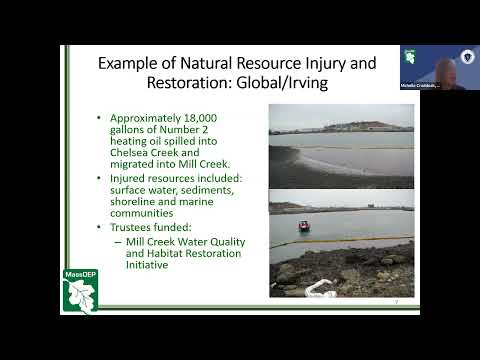
What the funding will target: Kratic said the grant will draw on remaining funds from several NRD settlements tied to spills that affected Chelsea Creek, Mill Creek and the lower Mystic River. She reported that, in total, just under $129,000 is available for projects. MassDEP emphasized that projects should restore or replace injured resources (wetlands, surface water, shoreline, aquatic biota) and demonstrate a clear link to the locations and services harmed by the releases.
Geography and project types: Projects must benefit the Chelsea River, Mill Creek or the lower Mystic River (Amelia Earheart Dam downstream to the Chelsea River), but MassDEP said upstream projects are eligible if they show downstream benefits. Examples given from past grants include wetland habitat creation, riverbank restoration and water‑quality improvements tied to spill injuries.
Who may apply and partnership encouragement: Eligible applicants include state and local governments, municipalities, local public authorities, individuals, partnerships, private nonprofits and quasi‑public corporations. MassDEP encouraged partnerships (for example, municipal–nonprofit collaborations) and said applicants may submit more than one distinct project proposal.
Application timeline and where to apply: Kratic said the procurement notice will be posted on MassDEP's NRD webpage and on the Commonwealth procurement site (COMMBUYS). Key estimated dates provided in the webinar were: posting around April 15; written questions accepted through May 1 (5 p.m.) with official answers posted by May 8 (5 p.m.); applications due May 29 (5 p.m.); award announcements around Aug. 1; and an estimated contract start of Sept. 1. MassDEP noted those dates are estimates and may shift.
What to include and how projects are evaluated: The application will include a standard form, project description and attachments (site photos, scope of work, operations and maintenance plans, community outreach plans, budget and a conflict‑of‑interest form). Evaluation criteria will prioritize: proximity and relationship to injured resources; magnitude and multiplicity of benefits; contribution to community goals and stewardship; avoidance of adverse impacts; and implementation readiness (site access/ownership, sound approach and cost reasonableness). Kratic said matching funds are not required but are encouraged and can strengthen an application.
Contracting and payment: Awards will be made as Commonwealth contracts subject to standard terms and supplemental NRD conditions. Kratic said the base contract period is typically three years from execution, with the possibility of up to two one‑year extensions at MassDEP's discretion. Payments will be made on a reimbursement basis.
Questions from participants: In response to participant questions, Kratic confirmed the webinar slides and recording will be posted online and that NRD grant funds can cover community outreach and staff time when those costs demonstrably support the on‑the‑ground restoration benefits and are not duplicative of previously obligated funding.
Next steps: MassDEP said it will post the formal grant announcement on COMMBUYS and its NRD webpage; applicants should watch those postings for full application materials and the official Q&A postings. Kratic provided contact information for follow‑up questions prior to the official posting.
The webinar recording and slides will be made available on MassDEP's website, and written application materials will be included in the procurement posting on COMMBUYS.