Get Full Government Meeting Transcripts, Videos, & Alerts Forever!
Get email alerts on the Transient Lodging Tax topic
No spam. Unsubscribe anytime.
Morrow County staff to draft ordinance exploring transient lodging tax to fund tourism and county services
Summary
County tourism officials presented a transient lodging tax (TLT) proposal outlining how a 3%–5% bed tax could fund destination marketing, events and park improvements; commissioners asked staff to prepare an ordinance for future consideration and public review.
Morrow County officials heard a presentation on a proposed transient lodging tax (TLT) and directed staff to develop an ordinance for the board’s consideration. Assistant County Administrator Vince Skero introduced the proposal on behalf of Morrow County Tourism and the regional Eastern Oregon Visitors Association, saying staff will return with draft ordinance language if the board wants to proceed.
"A transient lodging tax is a fee imposed on stays of less than 30 consecutive days," Carrie Welchley of Morrow County Tourism told the board, outlining state rules and how funds may be used. She said the state currently collects a 1.5% lodging assessment that will increase by 2027 and described the typical 70/30 allocation of TLT revenue between tourism promotion and local government uses, noting recent legislative changes that allow a 50/50 split in some circumstances.
Elena Carillo, executive director of the Eastern Oregon Visitors Association, placed Morrow County’s tourism metrics in regional context and described likely uses for TLT proceeds such as marketing, event support and modest infrastructure projects. She said data show the county currently has seven lodging properties (249 rooms), six campgrounds with RV sites, two hunting lodges and roughly 36 short-term rental listings, most concentrated around Boardman.
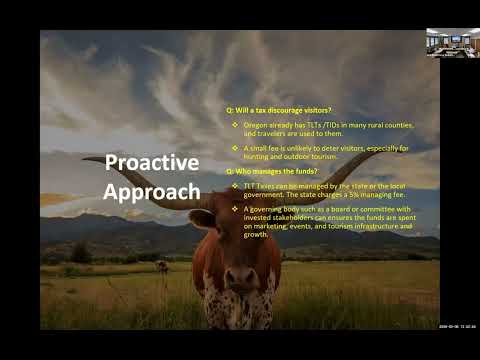
The presenters ran revenue scenarios showing that a 5% TLT at a high-occupancy case could generate roughly $189,000 for tourism uses (70%) with $81,000 available to the county general fund at a 30% share; switching to a 50/50 split would change the distribution to approximately $135,000 each, they said. They also noted administration options: the state can collect and remit funds (hoteliers remit one payment to Salem and distribution follows statute) or the county can set up local collection and distribution in ordinance language.
Commissioners asked about key details that would affect local receipts, including how long‑term worker stays (longer than 30 days) and RV flat fees would be treated; Welchley said state returns and quarterly filings can be used to analyze the local taxable base and that RV park charges can be handled by a per‑night flat fee written into an ordinance.
After questions and a discussion of resident impacts, board members expressed support for drafting an ordinance but did not take a formal vote. Skero summarized staff’s next step: gather lodging‑partner input, return recommended ordinance language and present a plan for committee or board administration of funds. "We can look at an ordinance and then we can go from there," one commissioner said.
The county will not put a TLT into effect without further board action; staff said they will return with draft ordinance language and a public outreach plan before any final decision.
Ending: The board directed staff to proceed with additional analysis and to prepare ordinance language and community outreach materials; no final action was taken at the meeting.