Get Full Government Meeting Transcripts, Videos, & Alerts Forever!
Get email alerts on the Homelessness topic
No spam. Unsubscribe anytime.
Oxnard City Council asked to decide future of Commission on Homelessness; staff recommends dissolution
Summary
City staff told council that limited staff capacity and strong regional structures at the Ventura County Continuum of Care mean the commission could be dissolved, retained with new rules, or replaced by an informal collaborative; staff recommended dissolution and emphasized continued city services and regional participation.
Samantha Shapiro, project manager in the city manager’s office, told the Oxnard City Council that staff recommends dissolving the Commission on Homelessness and relying on the Ventura County Continuum of Care (VCCoC) and other local partners to provide volunteer and policy engagement.
Shapiro said the recommendation comes after the Community Services/Public Safety/Housing & Development Committee voted in February 2026 to refer the issue to council and offered three options: dissolve the commission, keep it with revised rules, or create a less‑formal homelessness collaborative. She said the recommendation to dissolve reflects limited staff capacity to both support a Brown Act commission and participate meaningfully in on-the-ground work.
The staff report outlined how the VCCoC functions—an alliance, a board and subcommittees open to public participation—and noted that Oxnard participation in the VCCoC is necessary to remain eligible for some state and federal funding opportunities. Shapiro said Housing Director Brenda Lopez and Mayor Pro Tem Turn currently sit on the VCCoC board and that strong Oxnard representation in the countywide body helps ensure the city’s priorities are heard.
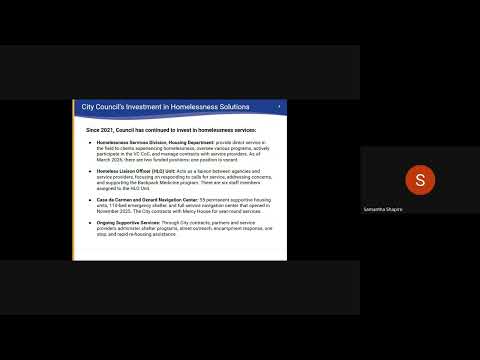
Shapiro presented recent local homelessness metrics and program activity: she said Oxnard experienced a 10.3% reduction in homelessness in 2024, a 15.7% reduction in 2025, and preliminary 2026 Point‑in‑Time results showing a 16.1% reduction. She also described city programs administered by the Homeless Services Division (street outreach, backpack medicine, one‑stop), noting two budgeted positions in the division and one vacancy; and said the Police Department’s Homeless Liaison Officer unit (six staff) responded to about 6,600 calls for service and recorded over 1,000 arrests in 2025.
Shapiro noted new capacity from Casa de Carmen and the Oxnard Navigation Center, which opened in November 2025 with 55 permanent supportive housing units and a 110‑bed emergency shelter with an on‑site navigation center. Other ongoing programs include rapid rehousing, encampment response and shelter contracts administered by city staff.
If the council retains the Commission on Homelessness, Shapiro said it would remain a Brown Act body with seven council‑appointed members, subject to Sunshine Ordinance and Measure M requirements and attendant administrative duties. Staff recommended a quarterly meeting schedule if retained and suggested considering membership criteria beyond the existing rule (must be 18 and an Oxnard resident), which would require a city code amendment.
As an alternative to a formal commission, staff described an informal homelessness collaborative—potentially convened by the mayor—that would not be advisory to council, would not have fixed membership or a fixed meeting schedule, and would limit elected‑official attendance to three to avoid triggering Brown Act requirements. Shapiro said the mayor has indicated interest in leading community input sessions if council votes to dissolve the commission.
Shapiro asked council to evaluate the staff report and provide direction; she said formal action would be needed only to amend the city code or to dissolve the commission, while convening an informal collaborative would not require formal council action. Staff will return with any necessary resolutions or ordinances based on council direction.
Staff will remain available to answer questions from council.