Get Full Government Meeting Transcripts, Videos, & Alerts Forever!
Get email alerts on the Behavioral Health Workforce topic
No spam. Unsubscribe anytime.
California launches $27.5 million fellowship funding to expand behavioral health specialists
Summary
The Department of Health Care Access and Information opened a $27.5 million organizational grant for California psychiatry and addiction fellowship programs to expand fellowship positions; applications are due April 15, 2026. Awards can fund up to $250,000 per new fellow per year, adjusted to time in medical safety-net settings.
The Department of Health Care Access and Information opened the Medical Behavioral Health Fellowship Training Program (MBHFTP) and announced approximately $27.5 million is available this funding cycle to expand child and adolescent psychiatry, addiction psychiatry and addiction medicine fellowship positions across California.
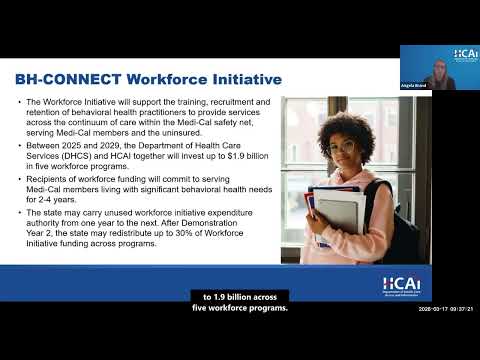
At a webinar introducing the program, Angela Brand, section chief for behavioral health and policy, said the fellowship is part of BH Connect, California’s behavioral health transformation under a CMS-approved 1115 demonstration waiver that enables statewide workforce investments. “Our work aims to expand equitable access to affordable care by strengthening the health workforce,” Brand said.
Ann Powell, who led the program overview, said awards will be prospective and may cover up to three years. “Programs can receive up to $250,000 per new fellow per year, adjusted for the percentage of time spent in a medical safety-net setting,” Powell said. She added that funds “must be used to supplement existing programs and not to supplant or replace funds the grantee has already” received from other sources.
The webinar set clear eligibility and reporting requirements. Daniela Perez, program officer for MBHFTP, said applicants must hold ACGME accreditation for the relevant fellowship tracks or, if approval is pending, supply proof of the ACGME request; official ACGME approval is required before an award is issued. For funded positions, trainees must spend at least 75% of rotation time in qualifying medical safety-net settings; awards will be adjusted to reflect the percent of time spent in those settings.
Lindsay Bradshaw, a project manager, explained how the program will link to HAI’s student loan repayment program: selected fellowship programs will identify interviewees, HAI will pre-qualify eligible individuals for a special repayment cycle, and HAI will enter individual agreements with matched trainees to administer loan repayment and monitor post-graduation service obligations.
HAI outlined application mechanics and scoring. The application has 12 sections including program information, rotation sites and time, budget, and required upload documents such as sustainability letters and ACGME approval letters (or proof of request). Scoring will consider rotation-site location in HAI-identified shortage areas, language capacity, prior fellowship cohort size, recruitment strategies to encourage practice in safety-net settings, and culturally responsive curriculum elements.
During a live Q&A, programs raised common operational questions. One attendee asked how to document ACGME approval when funding is not yet secured; staff offered individualized technical-assistance calls through the MBHFTP inbox. Another participant asked whether time spent rotating in Veterans Affairs settings counts toward the 75% medical safety-net requirement; Powell responded, “Veterans settings are not qualified as a medical safety-net setting.”
HAI said the MBHFTP application opened the day before the webinar and applications are due April 15, 2026, at 3:00 p.m. Anticipated award notices and the start of grant agreement work are expected in August 2026. Staff emphasized that if a position funded in an award is not filled, the grantee would not receive funding for that unfilled slot and advised programs with complex situations to seek case-specific guidance via technical assistance.
The webinar materials, slide deck and recording will be posted on the MBHFTP site, and HAI urged interested programs to sign up for notifications and the health workforce mailing list. For questions or to request technical assistance, HAI provided the inbox mbhftp@hai.ca.gov and phone 916-326-3700.
The application timeline and requirements mean programs should review the grant guide closely and, where appropriate, schedule a technical-assistance call before submitting their organizational application by the April 15 deadline.