Get Full Government Meeting Transcripts, Videos, & Alerts Forever!
Get email alerts on the Assessment Results topic
No spam. Unsubscribe anytime.
La Mesa-Spring Valley reviews assessment results, outlines math adoption and continuous-improvement plan
Summary
District staff presented state and local assessment results showing 47% ELA proficiency, a 1% math increase and a 5% science gain; the board heard a plan for common formative assessments, Spotlight students and a planned math-adoption pilot.
La Mesa-Spring Valley School District staff presented the district’s latest state and local assessment results and described steps to translate data into classroom practice.
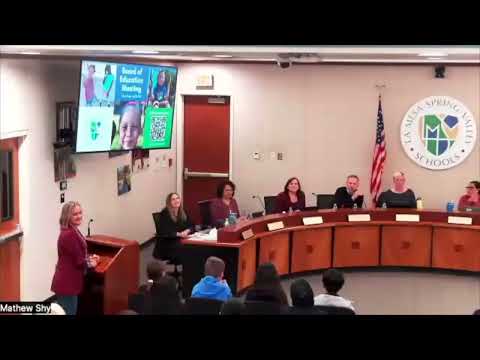
Matt Shai, executive director of leadership and technology, told the board the district’s California assessment results show 47% of students met or exceeded standards in English language arts, a 1% districtwide increase in math, and a 5% increase in science for assessed grades. Shai said the published state comparisons focus on students who “met” or “exceeded” standards and do not capture growth between adjacent performance levels.
Allison Long, who described the district’s continuous-improvement framework, said the district is expanding a data culture built on Instructional Leadership Teams, common formative assessments for grades K–8 and a Spotlight students strategy that targets a small group in each classroom to accelerate learning for the whole class. Long said common formative assessments will be used trimesterly and followed by student-data protocols to inform instruction.
Long and Shai told trustees the district is preparing a math-adoption process: a pilot next year followed by a full adoption the following year to align instruction with the new California framework. Shai said staff are identifying outlier districts and school-level promising practices to replicate where students made gains.
Principal Tammy Babbett described La Mesa Dale’s approach to building collective teacher efficacy and reported year-over-year gains at her school (reported in the presentation as approximately 6% ELA, 10% math and 12% science increases). She credited distributed leadership, peer observation, and common formative assessments for the gains.
Trustees asked for additional disaggregated comparisons and for information about which specific practices produced science gains; staff said they will provide school-by-school data and follow up on comparisons with similar districts.
The board was invited to review the district data dashboard and to meet with staff for deeper review. No formal action was taken on curriculum adoption at this meeting; the math pilot and adoption timeline remain staff recommendations to bring back for future board consideration.